
A Canadian business trading across North America learns to think of it as one market. One agreement governs the goods. One set of origin rules decides what qualifies. Freight is planned continentally, and a truck reaching Laredo is not a different kind of event from a truck reaching Windsor.
Then the money moves, and the single market stops existing.
There are three countries here, three central banks, three clearing systems and three regulatory regimes. A payment to Querétaro and a payment to Ohio have almost nothing in common except that both were invoiced in US dollars, and that decision was probably never made on purpose.
Meaford Filtration is an illustrative Ontario manufacturer of industrial filtration units, used throughout this guide — not a real company. It buys housings and motors from a supplier in Querétaro, assembles in Ontario, and sells roughly half its output to distributors in the American midwest. It invoices its US customers in US dollars and pays its Mexican supplier in US dollars. Its costs and payroll are in Canadian dollars.
Three legs, three counterparties, and one currency doing work in the middle of two relationships it does not belong to.
What the agreement governs, and what it does not
USMCA — CUSMA in Canada, T-MEC in Mexico — is a goods-and-services agreement. It sets tariff treatment, rules of origin, customs procedures, standards, labour and environment provisions, and dispute settlement. It is a comprehensive agreement about what crosses the border and on what terms.
It is not a payments agreement. There is no North American clearing system, no common settlement window, no continental rule on charge-bearer handling or FX disclosure. Nothing in the agreement determines how your money reaches your supplier, how long it takes, or what it costs on the way. That was never in scope.
Which is worth knowing right now, because the agreement's own status is unsettled and its payment silence is not.
On 1 July 2026 the USMCA Free Trade Commission held the mandatory six-year joint review required by Article 34.7. The United States did not confirm its intention to extend the agreement for a further sixteen years; the US Trade Representative stated that the United States "did not agree to renew the USMCA in its current form." Mexico and Canada each confirmed their support for extension. The agreement has not lapsed or expired — under Article 34.7.1 it runs to 1 July 2036, and a sixteen-year extension remains available at any point through written confirmation by the parties. What the decision did do is trigger the annual review process under Article 34.7.4, which now runs each year until the parties either agree an extension or the agreement reaches its term.
For a business, the operational reading is narrow and useful. The trade rules are live and under annual negotiation. The payment arrangements were never governed by the agreement in the first place, so nothing about the review changes them. Your origin position may be revisited. Your correspondent banking chain will not be, because no trade agreement was ever holding it up.
Three corridors, and why they are not alike
The three legs of North American trade look symmetrical on a map. In currency markets they are not close.
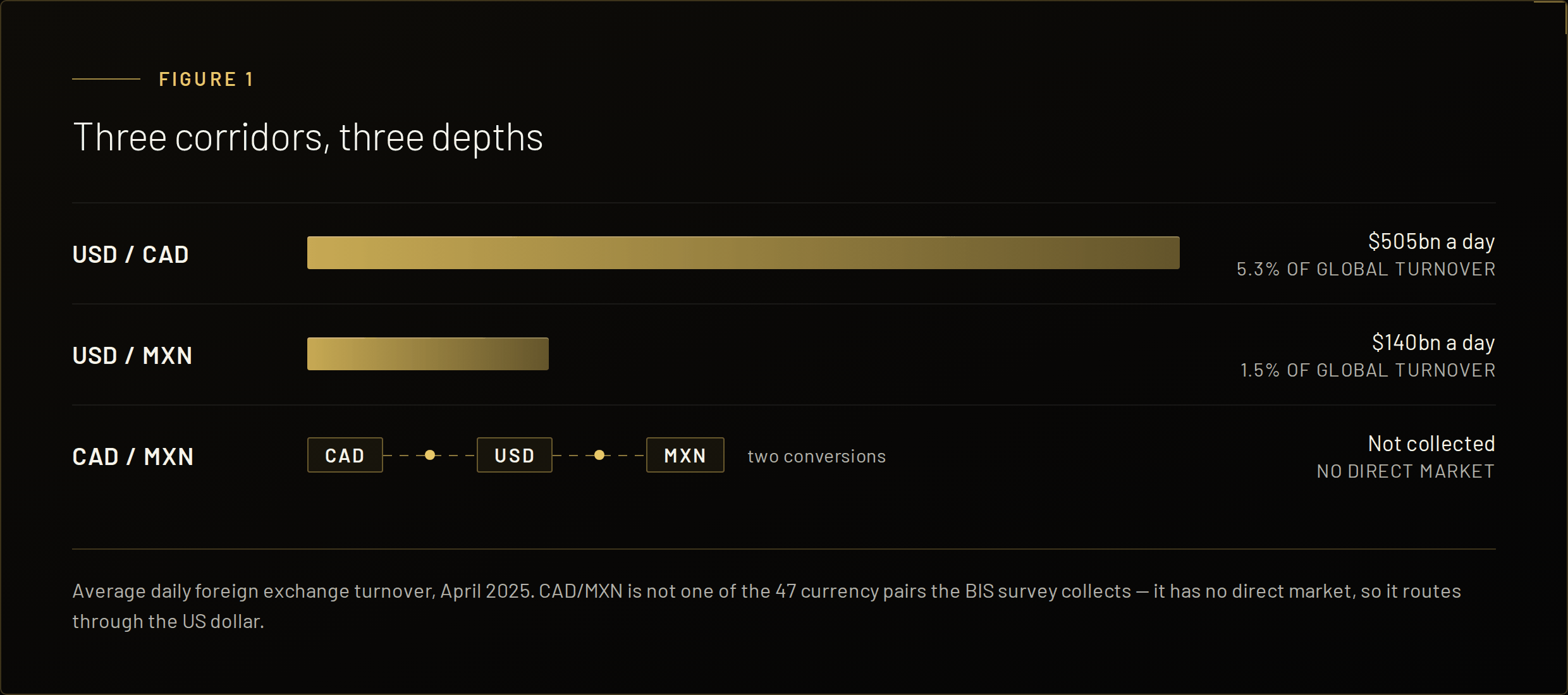
The Bank for International Settlements surveys global foreign exchange turnover every three years, and its April 2025 survey is the most comprehensive picture available. USD/CAD averaged $505 billion a day, or 5.3 percent of all global FX turnover. USD/MXN averaged $140 billion a day, 1.5 percent. Both are liquid, well-priced markets.
CAD/MXN does not appear in the survey at all. It is not among the 47 currency pairs the BIS collects; it falls into a residual category covering every unlisted pair in the world combined.
That absence is the whole story of the third corridor. There is no deep direct market between the Canadian dollar and the Mexican peso, so a CAD–MXN payment is not usually converted once. It is converted twice, through the US dollar as an intermediary. The BIS is explicit that this is how the market works: its own methodology records a cross-currency transaction passing through a vehicle currency as two separate deals against that vehicle currency. The dollar sits on one side of 89.2 percent of all FX trades globally, and the top ten currency pairs by turnover all involve it.
The cost consequence is direct. Two conversions means two spreads, on two legs, often quoted by two different institutions — and the second one is usually not visible to you at all. If your provider quotes a single CAD/MXN rate, ask whether they are pricing the pair directly or crossing it through the dollar, and whether the quoted rate contains one margin or two.
Where the money is deducted after that, and by whom, is the subject of a separate guide — see What Actually Happens to an International Wire. The corridor point here is narrower: before any of that begins, one of these three routes has already cost roughly twice what the others do, purely because of which currencies are on the ticket.
Invoice currency as a decision made by default
Most Canadian businesses trading in North America invoice and pay in US dollars on every leg. It is the path of least resistance. The counterparty accepts it, the bank quotes it, and nobody has to negotiate anything.
Meaford pays its Querétaro supplier in US dollars. Nothing about that transaction is a US transaction. A Canadian company converts CAD to USD, and a Mexican company converts USD to MXN, and neither of them wanted dollars. Both conversions happen. Only one of them appears in Meaford's accounts.
The second one has not disappeared. The supplier's bank converts the incoming dollars at its own rate, that cost sits in the supplier's own margin, and the supplier prices its goods accordingly. Meaford is paying for a conversion it cannot see, quote or compare, in a number that reaches it as "the price."
The remedy is not a rule about which currency is correct. It is a question worth asking once: ask the supplier for a price in their own currency, alongside the price in dollars. If the peso price is materially better than the dollar price converted at market, the difference was the supplier's conversion cost, and now it is on the table. If it is not, you have learned that too, at the cost of one email.
One thing Meaford should do before any of this. It receives US dollars from its American customers and pays US dollars to its Mexican supplier. Those flows partly cancel. Netting opposing flows in the same currency costs nothing and removes exposure at source — the point is made at more length in Forward Contracts, Explained, and it belongs before any conversation about hedging the remainder.
Where documentation meets payment timing
The document that determines your duty position and the document that starts your payment clock are frequently the same piece of paper.
A CUSMA claim requires a certification of origin. There is no prescribed form — CUSMA replaced NAFTA's certificate with a set of nine minimum data elements set out in Annex 5-A of Chapter 5, which may be completed by the importer, exporter or producer, and may be provided on an invoice or any other document, including electronically. The importer must have it in its possession at the time the claim is made, and must produce it to the border agency on request.
Two consequences follow, and both are cash-flow consequences rather than customs ones.
Your commercial invoice is a customs document. When the certification travels on the invoice, an origin error and an invoicing error are the same error. The supplier who gets the origin criterion wrong has also given you a document you may have to reissue, which moves the payment date.
The duty position can be settled long after the money has gone. Payment terms of net 30 from invoice will regularly have you paying the supplier before the customs position is finally resolved. Both countries provide for correcting it afterwards: in Canada a B2 adjustment request can be filed within four years of the goods being accounted for, and in the United States a post-importation claim under 19 USC 1520(d) within one year of importation. Record retention runs five years in the US and six in Canada.
Those windows are generous, and they are also a reminder. A refund arriving eighteen months later is a recovery, not a plan. The cash left when it left.
What tariff volatility does to a payment schedule
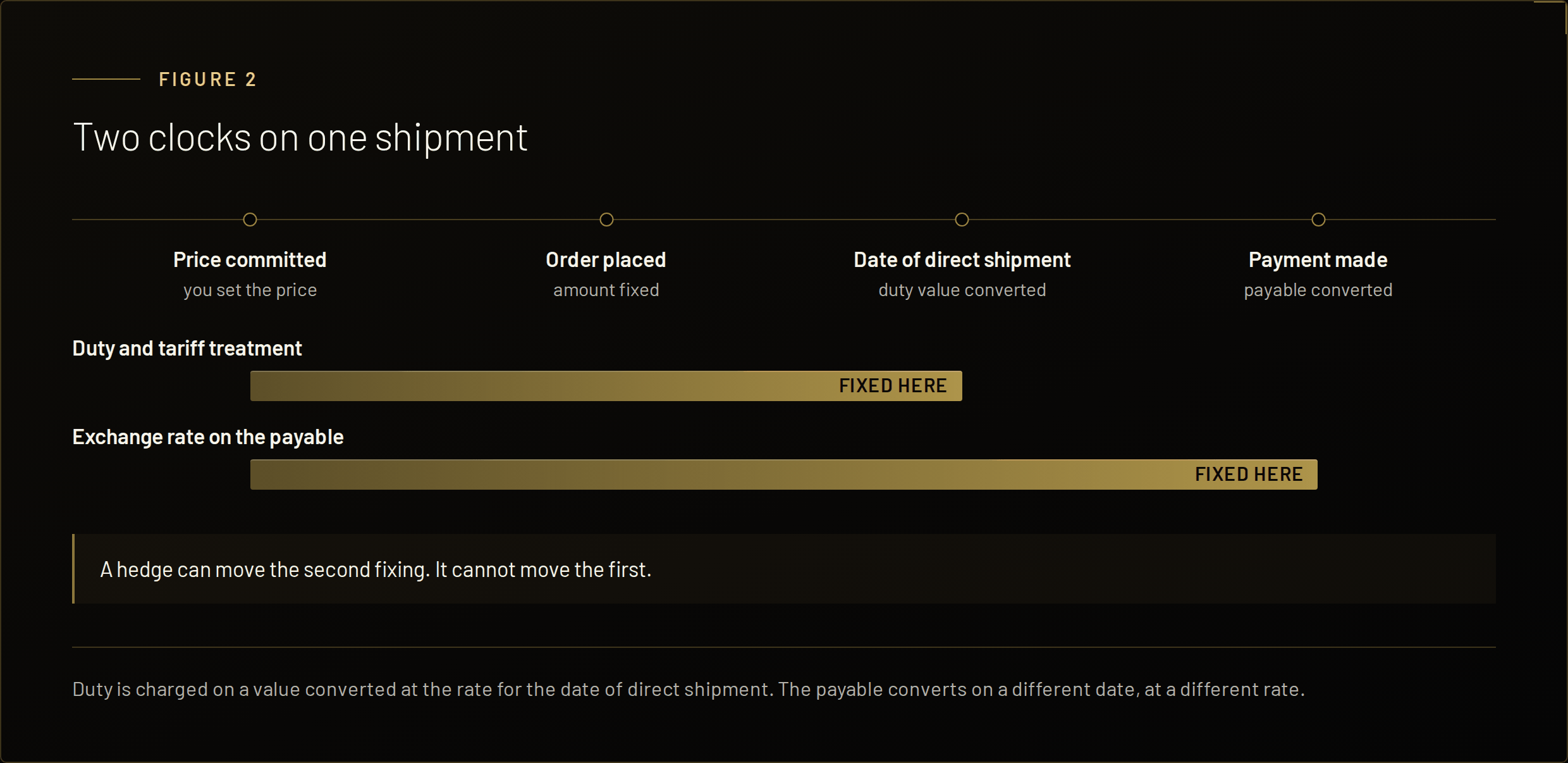
Between the day you commit to a price and the day you settle, the landed cost of a shipment has two moving parts: its duty treatment and the exchange rate. They move independently, on different clocks, and they multiply rather than add.
The multiplication is the part that gets missed. Duty is charged ad valorem — as a percentage of a value. For Canadian imports that value is converted at the Bank of Canada rate for the date of direct shipment, not the date you pay, under CBSA Memorandum D13-2-3. So a higher duty rate does not merely raise a cost. It enlarges the portion of your landed cost that is exposed to a currency rate you did not choose and cannot hedge to, because the date belongs to the shipment rather than to you.
There is a second structural point, and it is why "we are USMCA-compliant" has stopped being a complete answer to "what will this cost to land." A number of current measures sit outside the agreement and do not honour its origin rules. Canada's Trade Commissioner Service states plainly that goods qualifying for preferential duty-free treatment under CUSMA are not exempt from the US Section 338 tariffs applying to a range of Canadian imports as of 22 August 2026. Canada has announced countermeasures on US-origin goods effective 8 September 2026. Both are live and both sit alongside, not within, the agreement.
Nothing in this guide predicts where any of that goes. The planning question is not which way it breaks; it is how to hold a payment schedule together while it is unresolved. Three things follow from the mechanism rather than from any forecast:
- Separate the two variables. Currency risk is hedgeable and policy risk is not. Treating a hedge as protection against a tariff change produces a hedge sized for the wrong thing.
- Shorten the gap you control. The exposure is the distance between price commitment and settlement. Where terms allow it, a shorter gap is worth more in a volatile period than a slightly better rate on a longer one.
- Match the instrument to the certainty of the order, not to the news. A confirmed order with a known settlement date is a forward's job. An order that may not proceed at all is the case set out in Options Contracts, Explained. Neither instrument covers a duty rate.
Guidance by corridor
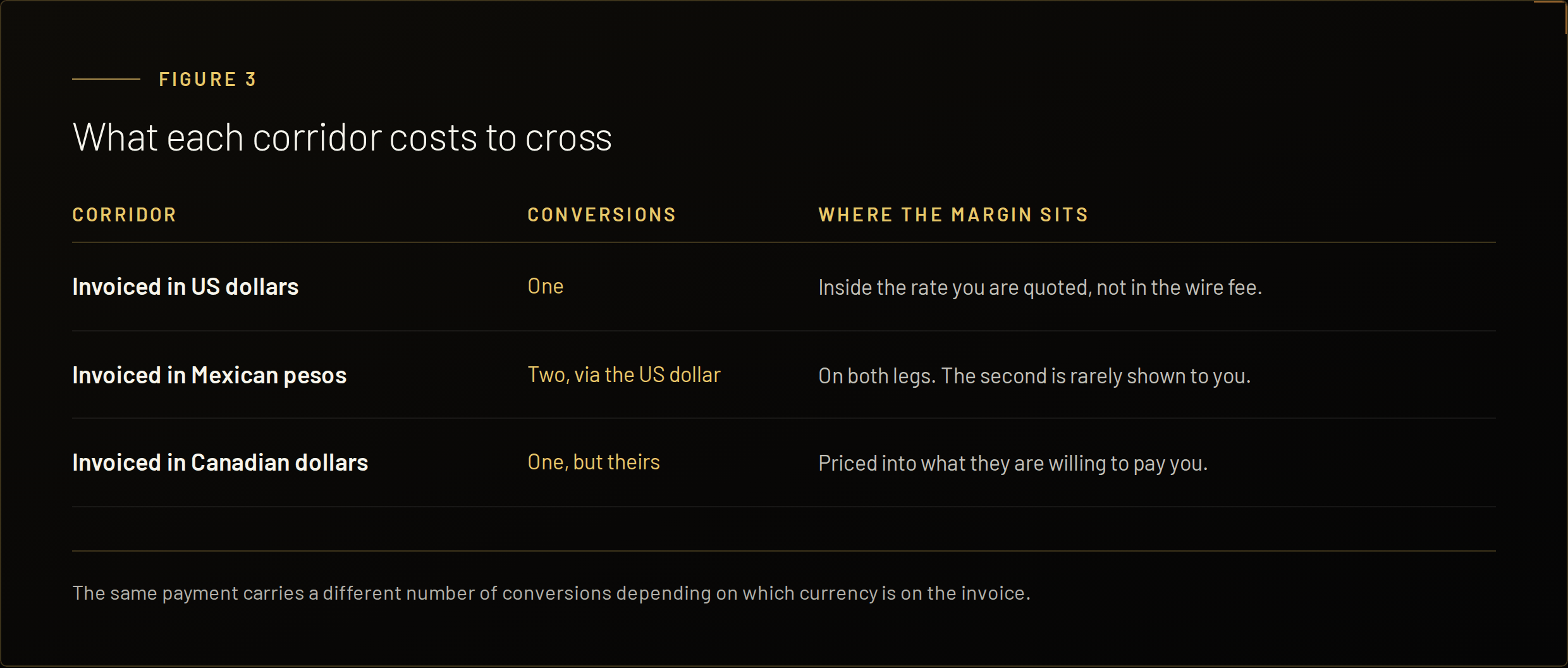
Paying or receiving US dollars. The deepest of the three corridors, and the one where a single conversion is enough. That does not make it cheap by default — the cost lives in the margin inside the rate rather than in the wire fee. Net your opposing US dollar flows before hedging anything, and benchmark the rate you are quoted against a published reference.
Paying or receiving Mexican pesos. The corridor with the double conversion. Ask your provider directly whether they price CAD/MXN as a pair or cross it through the dollar, and what the total margin is across both legs. Ask your Mexican counterparty for a peso price alongside the dollar price. Where you are paying in pesos, confirm which local rail the funds land on and what the receiving-side timing actually is, rather than assuming the US-corridor timeline applies.
Being paid in Canadian dollars by a US or Mexican counterparty. Appealing, and not free. The conversion has not been removed, it has been moved to the other side — and your counterparty will price it into what they are willing to pay, at a rate you no longer see. It is a reasonable thing to negotiate for. It is not a way to make the cost disappear.
In summary
North America trades as one market and settles as three. The agreement that governs the goods says nothing about the money, which is the single most useful thing to know about it — and the reason the payment side of your business is unaffected by a review that is otherwise unresolved.
What is left is a set of practical facts that do not change with the politics. One of your three corridors runs through a currency neither party uses. Invoice currency is a negotiable term that almost nobody negotiates. The document that clears your goods is often the one that starts your payment clock. And when duty rates move, they move the size of a currency exposure whose date you do not control.
None of that requires a treasury function. It requires knowing which corridor each payment is on, and asking the two or three questions the corridor makes relevant.
This guide is general information for Canadian businesses and does not constitute financial, legal, accounting, tax or customs advice. Trade measures affecting Canada, the United States and Mexico are subject to change, in some cases at short notice; all statements of tariff or agreement status are made as at 1 September 2026 and should be verified against current official guidance before being relied upon. Origin qualification, duty treatment and payment routing depend on the specific goods, corridor and provider involved. Consult your customs broker, your own advisers and your payment provider before acting.
Sources: Office of the United States Trade Representative, statement on the USMCA joint review (1 July 2026); USMCA/CUSMA Article 34.7 and Chapter 5 (Origin procedures) with Annex 5-A; Bank for International Settlements, Triennial Central Bank Survey — OTC foreign exchange turnover in April 2025 (30 September 2025); Canada Border Services Agency, CUSMA certification of origin guidance and Memorandum D13-2-3; Global Affairs Canada Trade Commissioner Service, guidance on US tariffs and CUSMA compliance; Department of Finance Canada, list of US products subject to counter tariffs; US Customs and Border Protection, USMCA guidance.