
Most Canadian importers are running an unhedged currency position whether they intend to or not.
If you buy in US dollars and sell in Canadian dollars, the gap between those two facts is a position. It has a size, a direction and a duration. Not hedging isn't neutral — it's a decision to carry that position at full size, renewed every time you cut a purchase order.
That may well be the right decision. If you can reprice quickly, or your margins absorb the swings, or your volumes are small, carrying it is defensible. What isn't defensible is carrying it by accident and finding out at year end.
How currency drift erodes margin
Currency conversations tend to focus on dramatic single-day moves. For an importer, the slow drift usually does more damage, because it compounds across every purchase order in a buying season. Here are the Bank of Canada's official annual average exchange rates for the US dollar:
- 2021 — 1.2535
- 2022 — 1.3013
- 2023 — 1.3497
- 2024 — 1.3698
- 2025 — 1.3978
An importer who set costs against the 2021 average and did nothing paid about 11.5% more Canadian dollars for the same US invoice by 2025. No single day in that window would have triggered a meeting. It shows up as gross margin quietly leaking, quarter after quarter, usually blamed on freight or supplier increases.
A worked example
Prairie Provisions is an illustrative Winnipeg housewares importer — not a real company. It buys about USD 6 million a year, roughly 70 percent of it between March and June for the autumn season. Revenue is around CAD 12.5 million at 34 percent gross margin, and its price list is set once a season, so it can't reprice mid-year.
A 6 percent adverse move on unhedged purchases costs it about CAD 497,000 — roughly four points of gross margin, gone.
Where currency exposure begins
Most importers think their currency risk begins when they issue a purchase order. It begins earlier, and it ends later, than that.
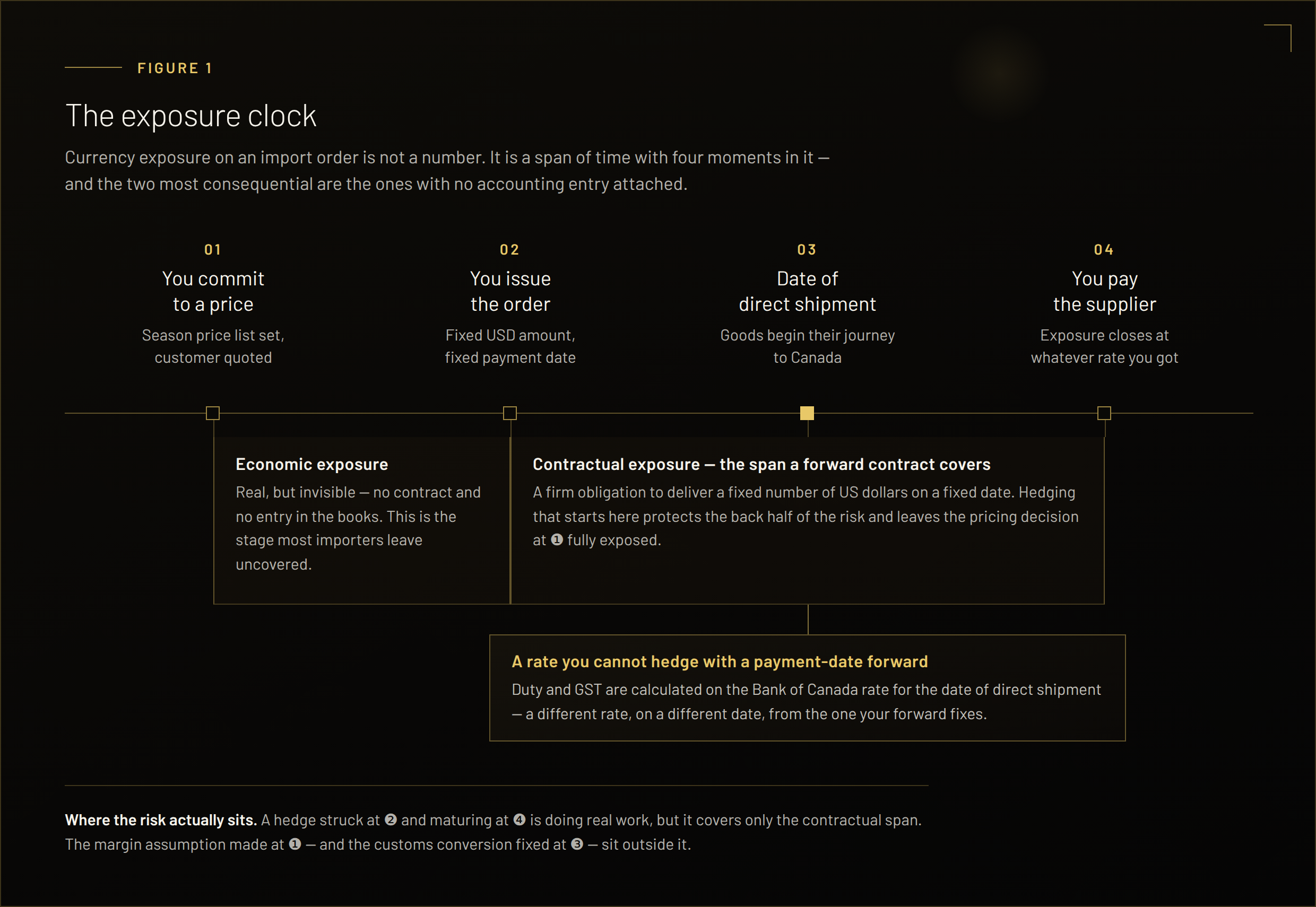
There are four moments that matter:
- You commit to a price. You set the season's price list using an assumed rate. Nothing is ordered and nothing is in the books, but your margin is now riding on that assumption. Most importers leave this stage completely uncovered.
- You issue the order. A fixed number of US dollars, due on a fixed date.
- The goods start their journey to Canada. More on this in a moment.
- You pay. Whatever rate you get is the rate you got.
For Prairie Provisions, moment one sits about nine months before moment four. Hedging from the purchase order onward protects the back half and leaves the pricing decision — the part that determines whether the season works — fully exposed.
The duty and GST exception
Duty and GST are calculated on the Bank of Canada rate for the date of direct shipment, not your payment date. That's set out in CBSA Memorandum D13-2-3. So even a perfectly hedged importer has a small piece of currency exposure sitting in its duty bill, at a rate it can't choose.
For most businesses it's a rounding error worth knowing about. If tariffs have pushed your duty rate into double digits, it's worth asking your customs broker to quantify it.
Setting the objective and the benchmark
This is the step that gets skipped, and skipping it is why most first attempts get abandoned.
The pattern is always the same. A company hedges. The Canadian dollar strengthens. The forwards settle at rates worse than spot. Someone says hedging cost the business 200,000 dollars this year, and the program quietly ends. Eighteen months later the dollar drops and the same meeting asks why nobody hedged.
Nothing went wrong with the hedging. What went wrong is that no objective was written down, so success defaulted to beating spot — a benchmark that requires knowing the future.
Pick one and write it down:
- Protect the budget rate. You need the rate you priced against to be the rate you get. This is Prairie Provisions.
- Protect a margin floor. You'll accept variance, but landed cost must never breach the point where a line stops making money.
- Smooth the volatility. You can pass costs through eventually, but you need time to do it without shocking customers.
- Lock one transaction. A single large order. One number, no ambiguity.
Then add one sentence: we measure this against our budget rate of 1.40, not against spot. It will save you a year of arguments.
Two public companies show there's no single right answer. Dollarama runs a systematic program, hedging the majority of forecast US-dollar merchandise purchases roughly nine to twelve months ahead. Aritzia discloses using forward contracts from time to time for the same kind of exposure. Similar businesses, opposite postures, both deliberate. Dollarama also tells shareholders plainly that hedging may limit gains if the US dollar weakens — which is what a stated objective buys you: the ability to say yes, and that was the deal.
How much of the exposure to cover
Cover should track how certain you are the purchase will happen. Hedge 100 percent of a forecast that lands 60 percent right and you're left holding US dollars you don't need.
- Contracted — signed PO or confirmed order — cover 80 to 100 percent
- Highly probable — the seasonal buy you place every year — cover 50 to 80 percent
- Forecast — a real estimate that could move — cover 0 to 40 percent
- Speculative — we might expand that line — cover nothing
Adjust these to your own forecast accuracy, which you can measure in an afternoon: pull last year's forecast against last year's actuals, month by month. If you were within 10 percent, you can commit further out. If you were off by 40 percent, shorten the horizon until forecasting improves.
Covering an exposure in instalments
The hardest question in hedging is when. Commit twelve months out and you're betting on volumes you can't be sure of yet. Wait until the order is confirmed and you take whatever the rate happens to be that week.
You don't have to choose. Cover the same purchase in instalments.
Prairie Provisions knows it buys heavily every June. Instead of hedging the whole June requirement on one day, it adds a slice roughly every six months, and makes the slice bigger as June gets closer — using the same certainty tiers above.
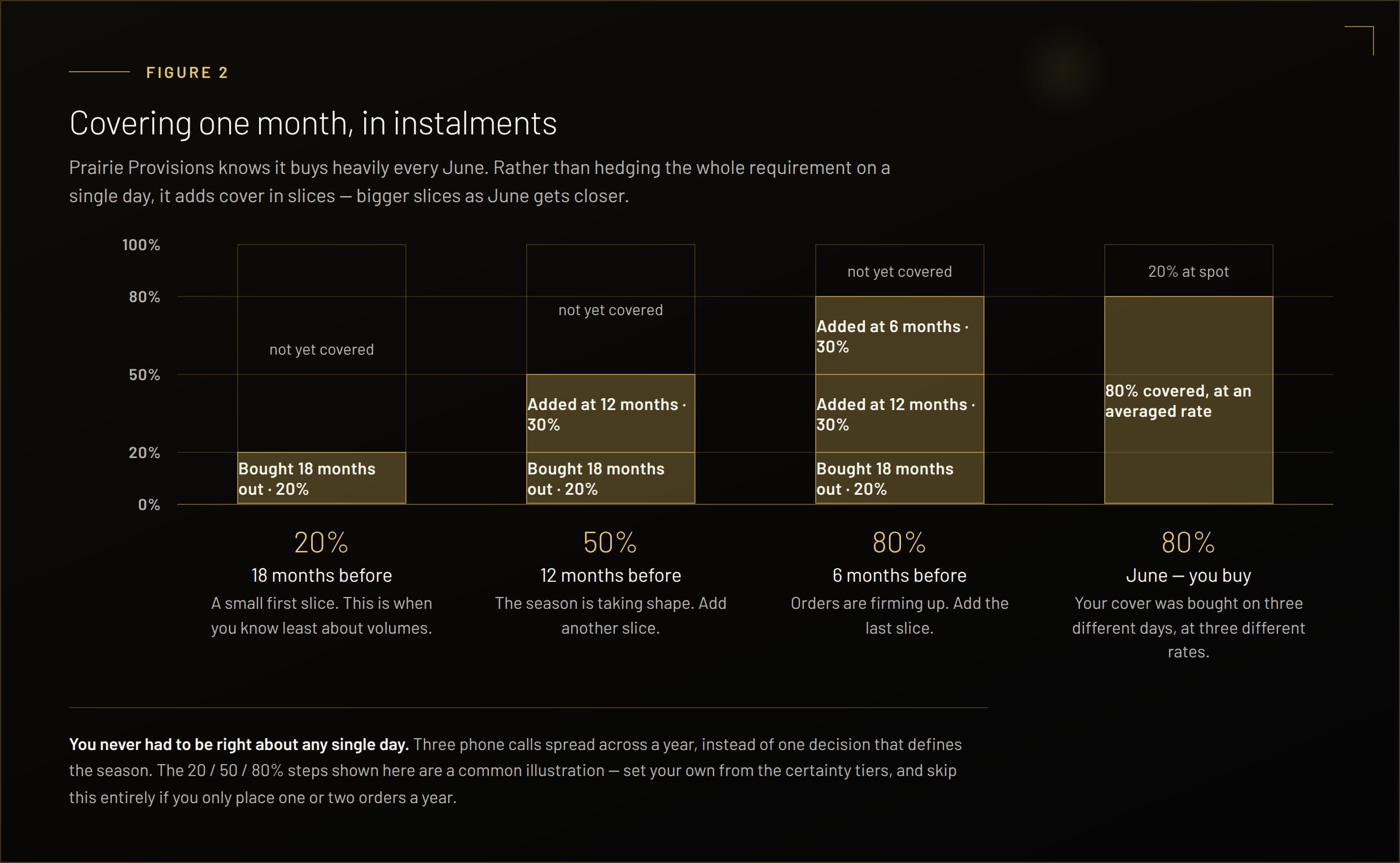
By the time June arrives, its cover was bought on three different days at three different rates. It never had to be right about any one of them. That's the whole point: not a better rate, but no single bad day defining your season.
Is this worth doing? If you buy roughly the same things at roughly the same times each year, yes — in practice it's a recurring calendar reminder and three conversations a year. If you place one or two large orders instead, skip it. Hedging each confirmed order as it's issued gets you most of the benefit with none of the admin.
Margin calls and the cash-flow trap
This is the one that catches people, and almost nobody is warned about it.
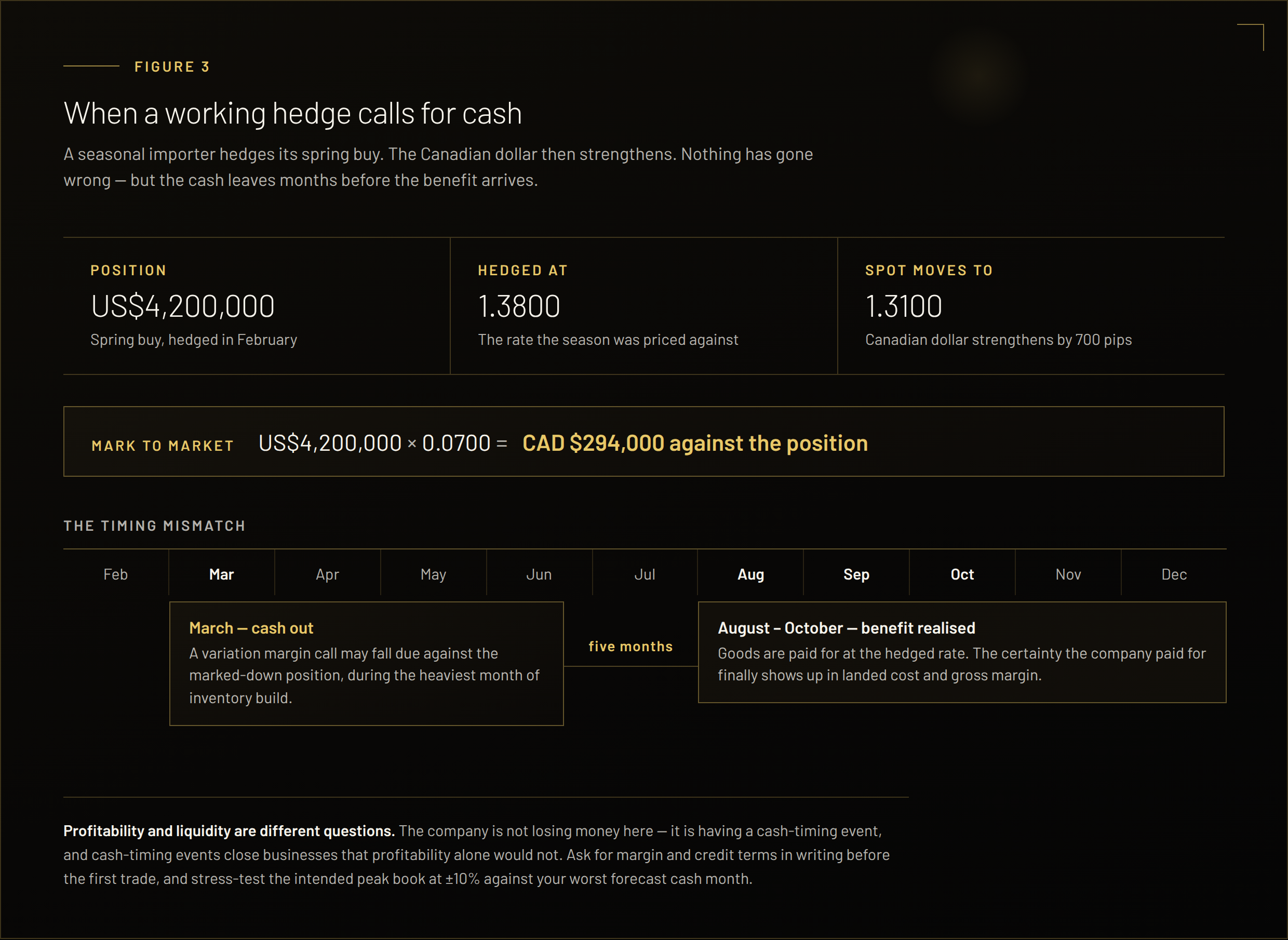
Prairie Provisions hedges USD 4.2 million of its spring buy at 1.3800. The Canadian dollar then strengthens to 1.3100. Overall this is fine — the hedge is doing its job and unhedged purchases got cheaper.
But the hedge position is now marked down by about CAD 294,000. Depending on the agreement, the provider may call for a large chunk of that in cash. In March. In the middle of the heaviest inventory build of the year. Against a benefit that won't arrive until goods are paid for months later.
The company isn't losing money. It's having a liquidity event — and liquidity events close businesses that profitability alone wouldn't.
What to do about it:
- Get the margin terms in writing before the first trade. Is there an upfront deposit? Is there a top-up call? At what trigger, and with how much notice?
- Take your intended hedge book and calculate what a 10 percent move does to it. Ask whether you could fund that in your worst cash month. If not, the program is too big for your balance sheet.
- Ask whether a credit line can replace cash collateral, and what that uses up in borrowing capacity.
Five questions worth asking a provider
- What's your spread, in writing? The rate you're quoted contains the provider's margin. Ask what it is and whether it changes by size and tenor. A provider who won't put it in writing has answered you.
- What are the margin and credit terms? See above. This is the question that protects your cash flow.
- What happens if my shipment is late? Standard forwards settle on one fixed date, and shipping dates move. Ask what an extension costs, and whether they offer a forward you can settle across a date range or draw down in stages — usually called a window or drawdown forward. For anyone importing on ocean freight, this is often worth more than a slightly better headline rate.
- How is my money held before it reaches my supplier? Segregated account, trust, insurance — ask.
- Are you registered, and can I verify it? Canadian FX providers register with FINTRAC as money services businesses, and payment service providers register with the Bank of Canada, which publishes both the registry and a list of refused or revoked registrations. Both are public and free to check.
A practical starting point
You don't need a treasury function. You need four things, in this order:
- Build a twelve-month calendar of expected US-dollar payments, split by how certain each one is, with the rate you assumed when you priced.
- Work out what a 10 percent move costs you — in gross margin points, not dollars. Points get attention.
- Pick your objective and write the one-sentence benchmark.
- Hedge one confirmed purchase order end to end before you do anything bigger. Find out where your process breaks on a trade that doesn't matter.
What hedging can and cannot do
Hedging doesn't make you money. Over time, a well-run program should land close to spot on average. What it does is narrow the range — fewer terrible quarters, fewer windfalls, and margins that reflect how well you buy and sell rather than how the currency moved.
For an importer running 15 percent gross margins, that's the difference between surviving a bad currency year and not.
If anyone pitches you a currency strategy on the basis that it will improve your average rate, ask how. The answer is always a forecast.
This guide is general information, not investment, tax, accounting or legal advice, and it doesn't account for your circumstances. Exchange rates fluctuate and hedging does not guarantee a favourable outcome. Speak to your own advisers before entering into any derivative contract.
Sources: Bank of Canada (annual exchange rates; payment service provider registry); CBSA Memorandum D13-2-3 and Customs Act s.55; FINTRAC money services business registry; Dollarama Inc. and Aritzia Inc. MD&A disclosures via SEDAR+.