
The Forward Contracts guide leaves one of its three cases without an answer. An engineering firm bidding in a foreign currency, three months from knowing whether it has won, is told that a fixed forward is the wrong instrument and that an option exists at the cost of a premium. Then the guide moves on. This is where it picks up.
The situation is more ordinary than the word derivative makes it sound. A tender you might not win. An acquisition that might not close. A seasonal order book that is not confirmed until dealers commit. In each case there is a foreign-currency amount real enough to plan around and not certain enough to commit to.
Kootenay Modular is an illustrative Cranbrook, British Columbia manufacturer of prefabricated building sections, used throughout this guide — not a real company. It has bid on a project south of the border priced in US dollars. The award decision is roughly four months away. If it wins, it will invoice and be paid in US dollars over the following year. If it loses, it will have no US dollar receipts at all.
The exposure a forward cannot hold
A forward is binding. That is its value, and here it is the problem.
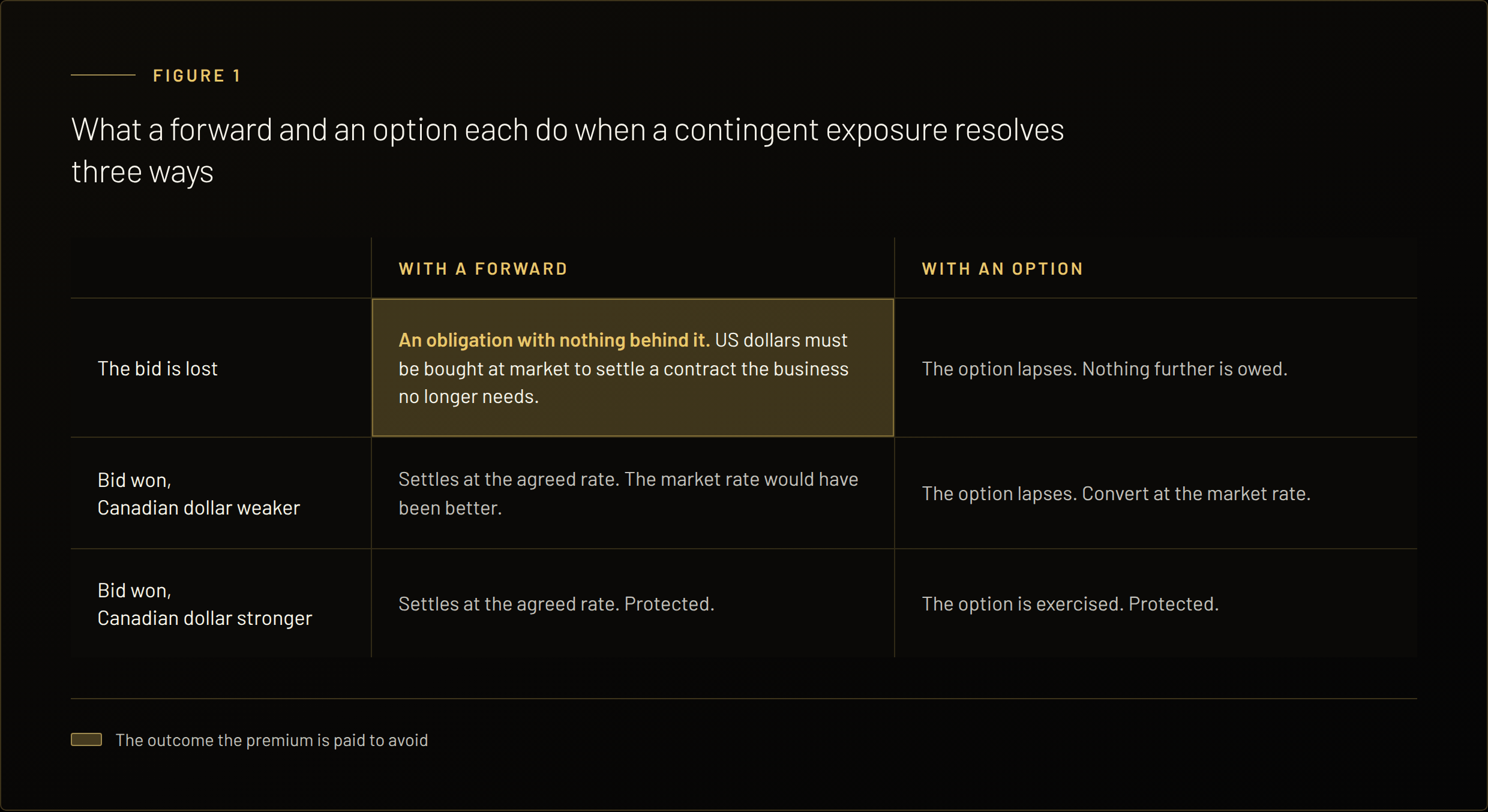
If Kootenay sells US dollars forward and then loses the tender, it holds an obligation to deliver US dollars it will never receive, and has to buy them at whatever the market offers on the settlement date. A commercial uncertainty — did we win the work — has become a financial one, on a contract the business never wanted.
The exposure is contingent: it exists only if something else happens first. Forwards have no setting for that.
A right rather than an obligation
A foreign exchange option gives its buyer the right, but not the obligation, to exchange a set amount of one currency for another at an agreed rate on an agreed date. The seller carries the mirrored obligation. In a straightforward hedge, you are the buyer.
That asymmetry is the entire product. Kootenay's year can end three ways, and in two of them the option goes unused: it loses the tender and has nothing to convert, or it wins and the market rate turns out better than the option's. Only in the third — it wins and the Canadian dollar has strengthened — does it exercise. Going unused twice is not a failure of the instrument. Being able to walk away is what was purchased.
Options remain a modest corner of the market: the Bank for International Settlements' 2025 Triennial Survey put FX options at 7 percent of global turnover, up from 4 percent in 2022, and notes they are used both to hedge currency risk and to speculate on it. The same instrument serves both purposes, which is one reason it can be sold in two very different registers.
Where the premium comes from
Here is the honest centre of the product, and the part most likely to be underplayed.
A forward costs nothing on the day you enter it. An option costs money on the day you enter it.
The premium is cash. It is quoted up front, payable within a couple of business days of the trade, and it is not refundable. It is not a deposit, not margin, and not credited against the eventual exchange. Once paid it is spent — and it is spent whether or not the option is ever used.
That is uncomfortable, and it should be looked at directly. If Kootenay loses the tender, the premium bought nothing that appears on an invoice. What it bought was four months in which the business held no currency obligation it could not escape. So the comparison is not option versus forward rate — those are not alternatives here. It is: what would it have cost to be wrong about a binding commitment on a contract we might not have won?
Offered strictly as an analogy, the premium behaves the way an insurance cost does: you pay it, you hope not to need it, and not needing it does not make it a bad purchase. Options are not insurance contracts and are not regulated as such, but the mental accounting is right. Premium is an expense, and its recognition depends on your reporting framework — discuss treatment with your accountant before the trade, not at year end.
Buying and selling the foreign currency
Which option you need falls out of the direction of your exposure.
- If you will owe foreign currency — an importer, or a company paying for an acquisition in sterling — you need the right to buy that currency at an agreed rate.
- If you will receive it — an exporter, or Kootenay if it wins — you need the right to sell it at an agreed rate.
The words call and put attach to those, and they carry a trap. Every currency option is a call on one currency and a put on the other at the same time; the label depends on which currency the provider names first. A "USD put" and a "CAD call" can be the identical contract.
Do not resolve this by learning the convention. Ask the provider to state the contract as a sentence: the right to sell US dollars and buy Canadian dollars, at this rate, by this date. If they will not put it that way, that is information too.
Choosing a strike
The strike is the rate the option lets you deal at. Choosing it is the real decision, and it is a straight trade between cost and protection.
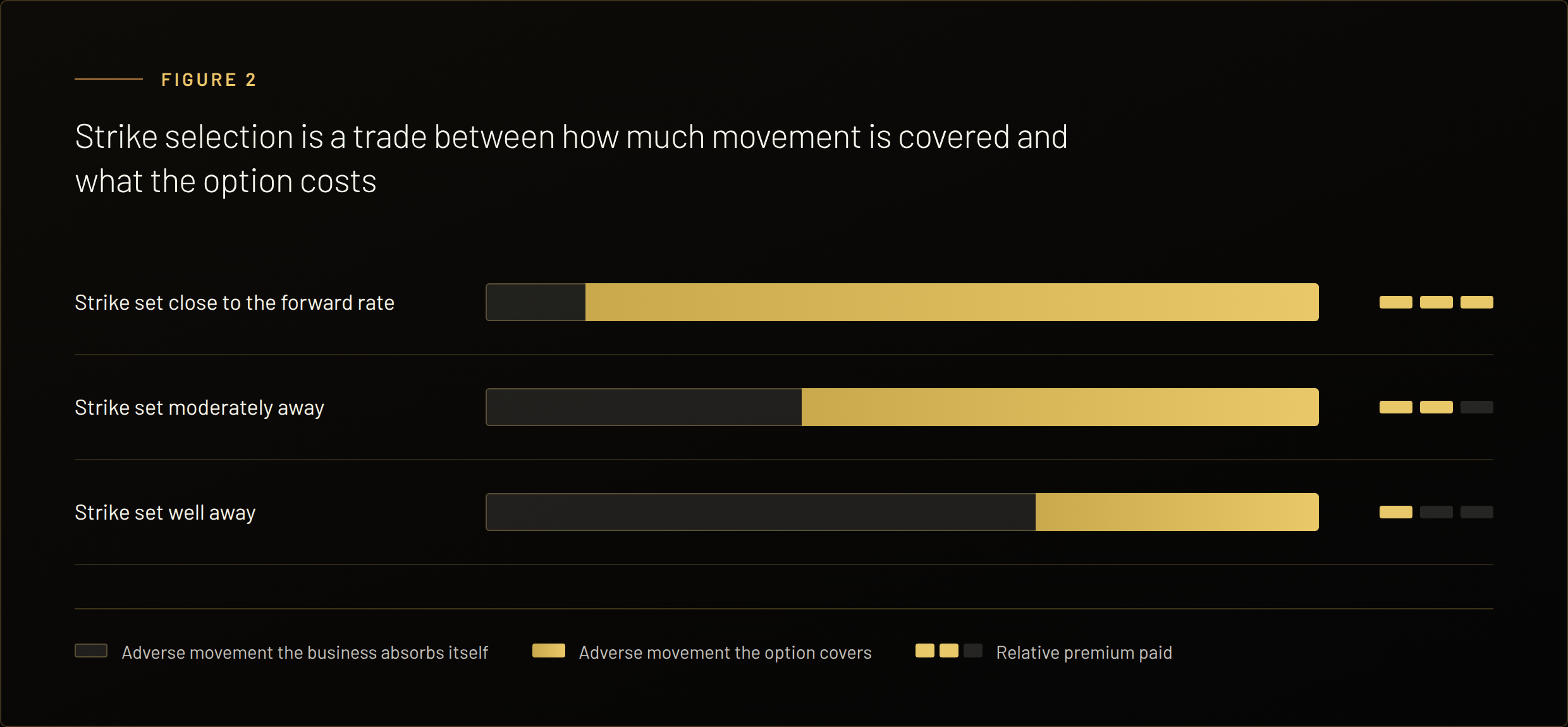
The reference point is not today's spot rate but the forward rate for your date, for the reasons set out in the Forward Contracts guide. A strike close to that rate protects nearly the whole exposure and costs the most. A strike further away leaves a band of adverse movement uncovered before protection engages, and costs less. A cheaper option is not a better deal; it is less protection, priced accordingly.
Start from the rate the business needs, not the premium you would prefer to pay. Kootenay priced its bid at a particular rate, and everything worse than it erodes a margin already committed to in the tender. That rate is the candidate. Protection begins where you put it.
What moves the premium
Three things, directionally. You do not need to price an option, only to recognise why two quotes differ.
- Expected volatility of the pair. The more movement the market anticipates, the more a right to walk away is worth. This concerns expected movement, not expected direction.
- Time to expiry. Longer costs more; there is more time for the rate to move.
- Distance of the strike from the forward rate. Further away is cheaper, and covers less.
One practical consequence: premiums cannot be shopped the way a spot rate can. Unless pair, amount, strike, expiry and structure are identical and quoted the same day, competing quotes are not comparable. Fix the terms first, then ask two or three providers to price that exact contract.
When an option is the wrong instrument
Plainly: a contracted payment on a known date is a forward's job.
If the purchase order is signed, the amount fixed and the date set, the transaction is going to happen. The right to walk away has no value to you, because you are not going to walk away. Buying it anyway is money spent on optionality the business does not need.
An option is also wrong when it is used to express a view — buying the right to convert at a favourable rate because you expect the market to move a certain way. That is a position, not a hedge, and it should be recognised as one before it is entered rather than after. Most businesses with both kinds of exposure end up with both instruments: forwards against what is contracted, options against the slice that is genuinely contingent.
Collars and zero-cost structures
At some point in a conversation about premium, a provider may offer to reduce or remove it. The mechanism is a collar: alongside the option you are buying, you sell one in the opposite direction, and the premium received offsets the premium paid. Tuned so the two cancel, it is presented as zero cost.
Three things need saying.
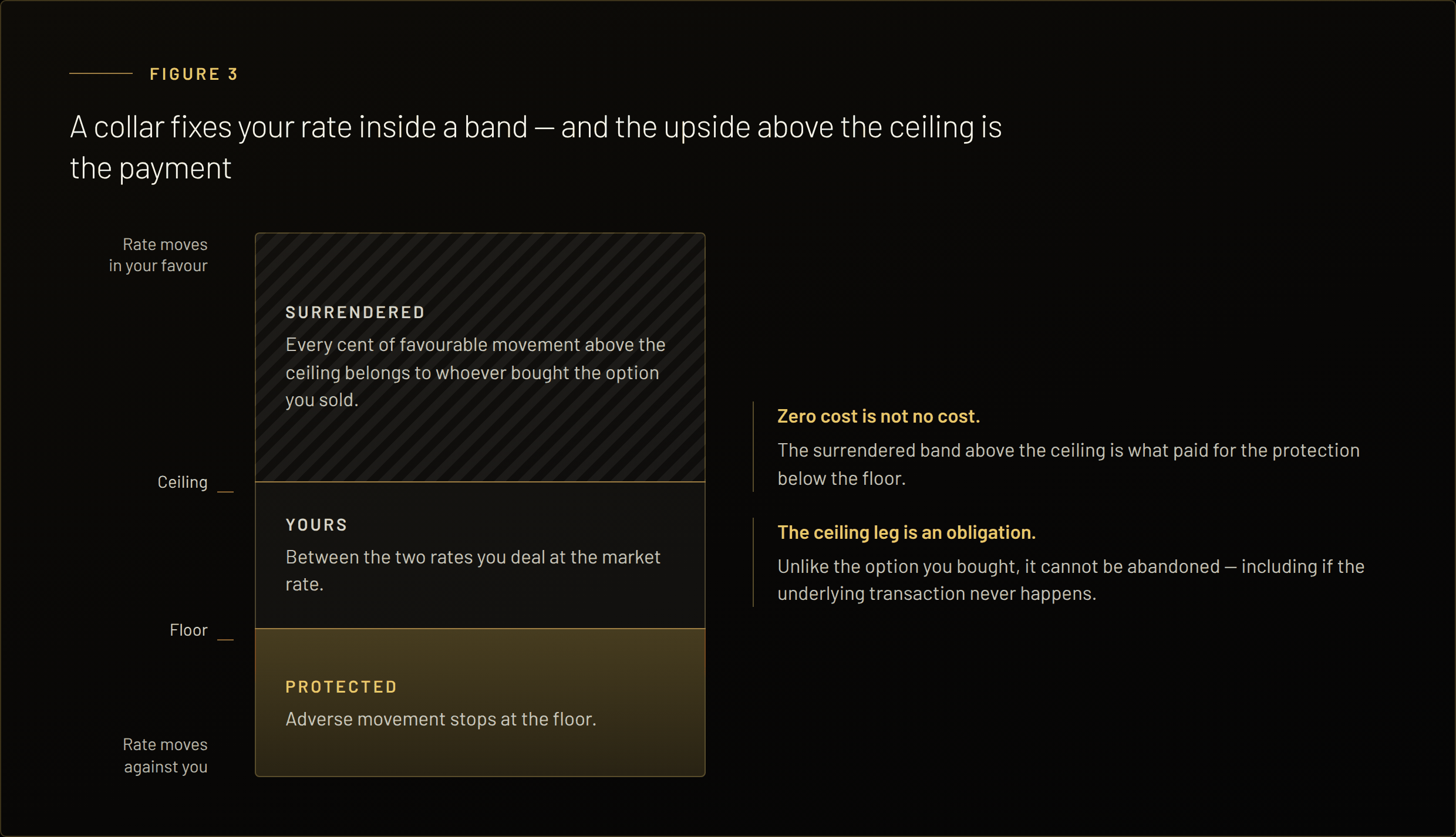
Zero cost describes the premium, not the risk. Nothing was given away by the provider. You paid for your protection by selling your own favourable movement beyond a certain rate. The cost is real; it has moved from an invoice into a rate you will not receive.
The result is a band. Movement against you stops at the floor. Movement in your favour is yours only up to the ceiling. Beyond it, the gain belongs to whoever bought the option you sold.
The leg you sold is an obligation, and you cannot walk away from it. This matters most in exactly the situation this guide is about. If Kootenay collars its tender exposure and then loses the bid, it abandons the leg it bought and remains bound by the leg it sold. The contingency problem the option was purchased to solve has been partly reintroduced.
Structured variants go further: knock-in and knock-out triggers that switch the contract on or off at particular rates, and leveraged structures where the notional on the leg you sell is larger than the one you buy. These have a documented history of severe corporate losses. The BIS recorded that after sharp currency depreciation in late 2008, companies in Brazil and Mexico that had sold FX options offshore were forced by knock-in provisions to sell double the amount of US dollars at unfavourable rates; Mexican corporate derivatives losses reached USD 4 billion in the fourth quarter of 2008, Brazilian losses were expected to run far higher, and one major Mexican retailer sought bankruptcy protection that October after losses of up to USD 1.1 billion on related contracts. In a different market and a different underlying, the UK's Financial Conduct Authority treated structured collars sold to non-sophisticated customers as unsuitable and took them directly into its redress scheme without testing whether the individual sale was fair. Those were interest rate contracts, not currency ones. The design family is the same.
None of this makes a collar improper; businesses use them deliberately and with their eyes open. It means the test is stricter. If you cannot state in one sentence what you are obliged to do, at what rate, on what amount, and in what circumstances, the answer is not yet.
What happens at expiry
Expiry is undramatic, which is worth knowing in advance. The option is either used or it lapses. If the strike is better than the market rate, you exercise and the exchange settles like any other currency trade. If the market rate is better, you let it lapse and deal at market. Nothing is owed for not using it — no penalty, no fee, no residual obligation. The premium was paid at the start and that was the whole cost.
Four mechanical points to confirm before you trade, not on the day:
- Whether exercise is automatic, or whether you must instruct it.
- The cut-off time. Expiry has a time as well as a date. Missing it is a real way to lose protection you paid for.
- The style. European options are exercisable only at expiry, American at any point up to it. Most corporate currency hedging uses European.
- What happens if the transaction moves. The option does not move with it. It holds value until expiry and can usually be sold back for what it is worth.
Questions worth asking a provider
- Stated as a sentence: which currency does this give me the right to buy, which to sell, at what rate, and by what date and time?
- What is the premium in dollars, when is it payable, and is any part of it refundable?
- What is the forward rate for the same date, and how far from it is this strike?
- Is exercise automatic, and what is the cut-off on the expiry date?
- What would it cost to unwind this before expiry?
- If more than one leg is involved: what am I obliged to do, at what rate, and on what amount? Is the amount on the leg I am selling the same as the amount on the leg I am buying?
- Does any part of this require a credit facility or margin?
In summary
An option does not improve your exchange rate and is not a way to be right about the market. It is a way to pay a known amount today to avoid taking on an obligation you are not yet in a position to take on.
For an exposure that might never exist, that is worth something. For one already contracted on a known date, it usually is not — that is what a forward is for.
The premium is the honest part of this product: visible, quoted before you commit, and the most you can lose. Treat with corresponding care any version in which the premium disappears, because the cost has not disappeared with it. It has only moved somewhere harder to see.
This guide is general information for Canadian businesses and does not constitute financial, legal, accounting or tax advice. Foreign exchange options are derivatives. Buying an option risks the premium paid; selling an option, including as part of a collar or structured contract, creates obligations whose cost is not limited to the premium received and may substantially exceed it. Accounting and tax treatment vary by reporting framework. Consider your own circumstances and take professional advice before entering into any hedging arrangement.
Sources: Bank for International Settlements, Triennial Central Bank Survey — OTC foreign exchange turnover in April 2025 (30 September 2025); Bank for International Settlements, "Derivatives-related exposures in the corporate sector: the case of Mexico and Brazil", BIS Quarterly Review (June 2009); Financial Conduct Authority, Interest Rate Hedging Products review and redress scheme.