
Most Canadian businesses meet currency risk before they think about hedging it. A purchase order is signed in US dollars in March and settles in September. Nobody does anything wrong in between, and the cost of the order changes anyway.
A forward contract is the most direct answer to that problem, and the most widely misunderstood. It is often described as a way to get a better rate, which it is not. It is a way to stop the rate from being a variable in your planning.
This guide covers what a forward commits you to, how its price is set, and the part most explanations skip: how to work out which of your own exposures are worth covering.
Where forwards fit in a Canadian business
Before the mechanics, it is worth recognising the situations. If any of these describe your business, currency is already affecting your margin whether or not you are managing it.
- Importing inventory or components priced in USD, EUR, CNY or MXN, with payment terms of 30 days or more
- Buying capital equipment from an overseas manufacturer, where the deposit and the balance fall in different quarters
- Exporting with foreign-currency receivables: you invoice in USD and get paid in 60 days
- Bidding or tendering in a foreign currency, where you commit to a price months before you know whether you have won
- Paying overseas contractors or staff on a recurring monthly cycle
- Servicing foreign-currency debt or lease obligations on a fixed schedule
- Repatriating funds from a foreign subsidiary on a known timetable
The common thread is a known or highly likely foreign-currency amount, on a known or approximate future date. That combination is what a forward is built for.
What a forward contract is
A foreign exchange forward is a binding agreement to exchange one currency for another, at a rate agreed today, on a date in the future.
Three things are fixed when you enter it: the currency pair, the amount, and the settlement date. The rate is fixed too, but it is not today's rate. It is today's rate adjusted for the interest rate difference between the two currencies over the life of the contract.
The word doing the most work is binding. A forward is an obligation, not an option. On the settlement date the exchange happens whether the market moved in your favour or against you, and whether or not the underlying commercial transaction went ahead. That single characteristic drives most of the practical guidance below.
Why the forward rate is not a forecast
This is the point most often misread, and getting it right changes how you evaluate a quote.
When a provider quotes a rate for settlement in six months that differs from today's spot rate, that difference is not a view on where the currency is heading. It is arithmetic.
The logic: suppose you need US dollars in six months. You could borrow Canadian dollars today, convert at spot, and hold the US dollars for six months, earning US interest and paying Canadian interest. Or you could enter a forward. If those two routes produced different outcomes, anyone could borrow in one currency, lend in the other, and pocket the difference risk-free. Competition closes that gap. The forward price sits where both routes cost the same.
- When Canadian interest rates are higher than those of the other currency, the Canadian dollar trades at a forward discount. Buying foreign currency forward costs more than spot.
- When Canadian interest rates are lower, the Canadian dollar trades at a forward premium. Buying foreign currency forward costs less than spot.
The adjustment is quoted as forward points, added to or subtracted from spot. The further out the date, the larger the adjustment.
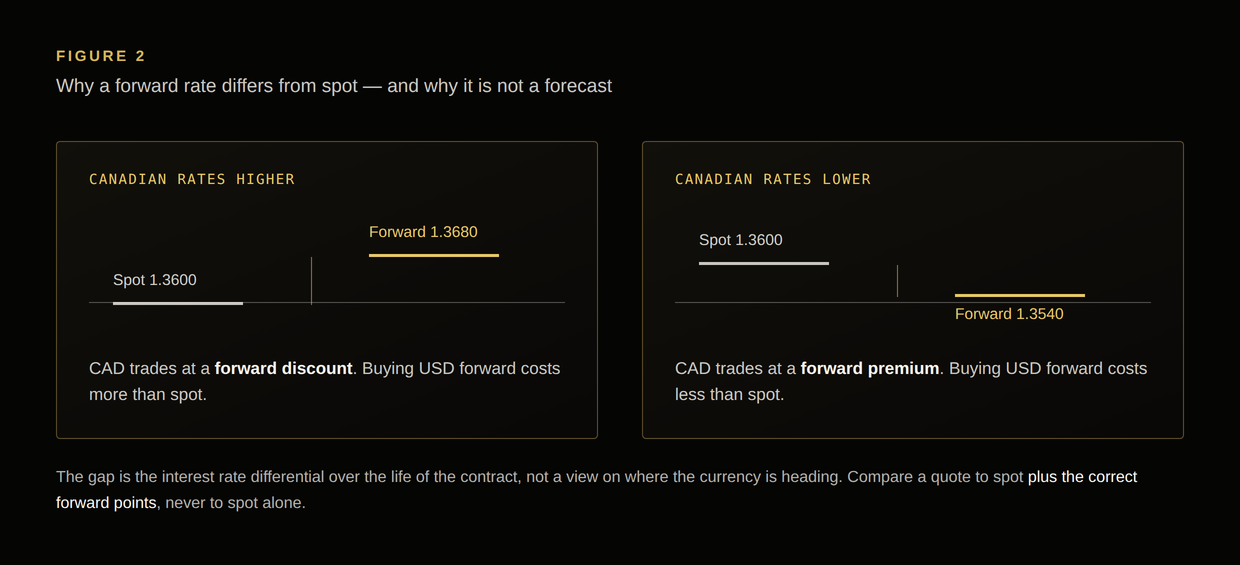
Judge a forward quote by comparing it to spot plus the correct forward points, never to spot alone. A forward that prices worse than spot is not a markup, and one that prices better is not a bargain. If a provider cannot explain the points on your quote, ask them to.
Three businesses, three decisions
1. The importer: certainty on a signed order
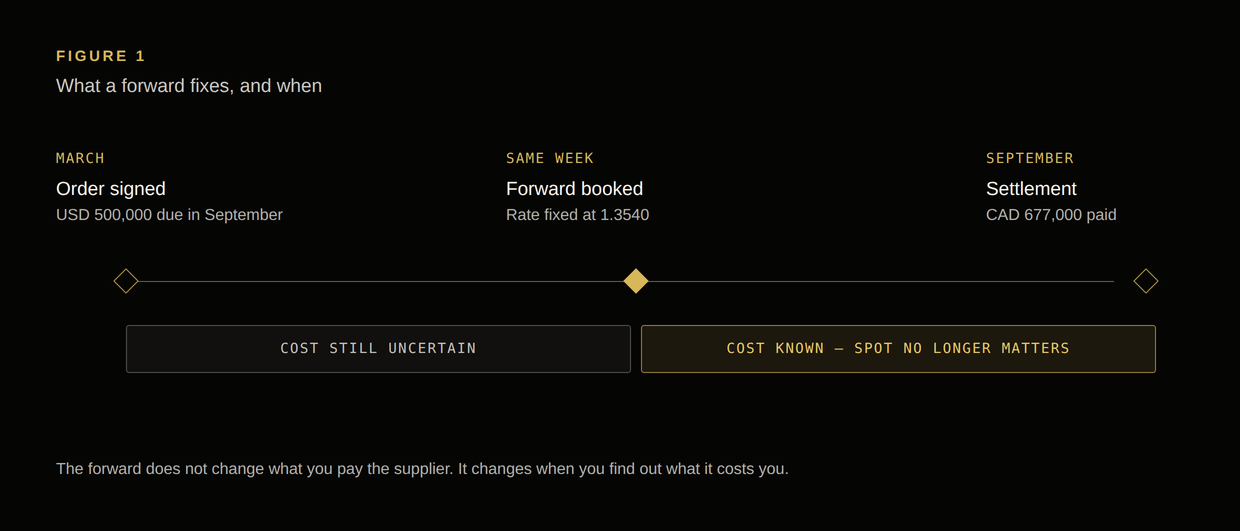
A Manitoba equipment distributor signs a USD 500,000 order in March, payable in September. Spot is 1.3600. The costing assumed 1.3700, so there is a little headroom before margin is affected.
The exposure is contracted: the amount is known, the date is known, and the order will not disappear. This is the clearest case for a fixed-date forward. The distributor locks the September rate in March and knows the landed cost immediately.
They can now quote customers for the autumn with confidence, because the largest input cost is fixed. Note what the forward did not do. It did not make the equipment cheaper. It made the price knowable four months earlier than it otherwise would have been.
2. The exporter: protecting a receivable
A BC manufacturer invoices a US customer USD 300,000 on 60-day terms.
This is the mirror image of the importer, and the one businesses more often leave unhedged, because a receivable feels like money already earned. It is not. It is a US dollar amount whose Canadian value is unknown until it lands. If the Canadian dollar strengthens over those 60 days, the invoice is worth less than the one booked in the accounts.
Here a forward to sell USD fixes the Canadian value of the receivable. The practical wrinkle is timing, because customers pay late. A window forward, which allows settlement across a date range rather than one specific day, absorbs that slippage without requiring the contract to be rolled.
3. The bidder: when a fixed forward is the wrong tool
An Ontario engineering firm bids on a EUR 2 million contract. The result will not be known for three months. If they win, payments run over the following year.
This is the case where reaching for a forward is a mistake. The exposure is contingent, existing only if the bid succeeds. A fixed forward would leave the firm holding a binding obligation on a contract they may not have won, converting a commercial uncertainty into a financial one.
Better approaches: hedge nothing until the outcome is known and price the currency risk into the bid, or use an option, which confers a right rather than an obligation, at the cost of a premium. Once the contract is won and the payment schedule is known, forwards become appropriate, most likely a drawdown forward settling in instalments against each milestone.
How to decide what to cover
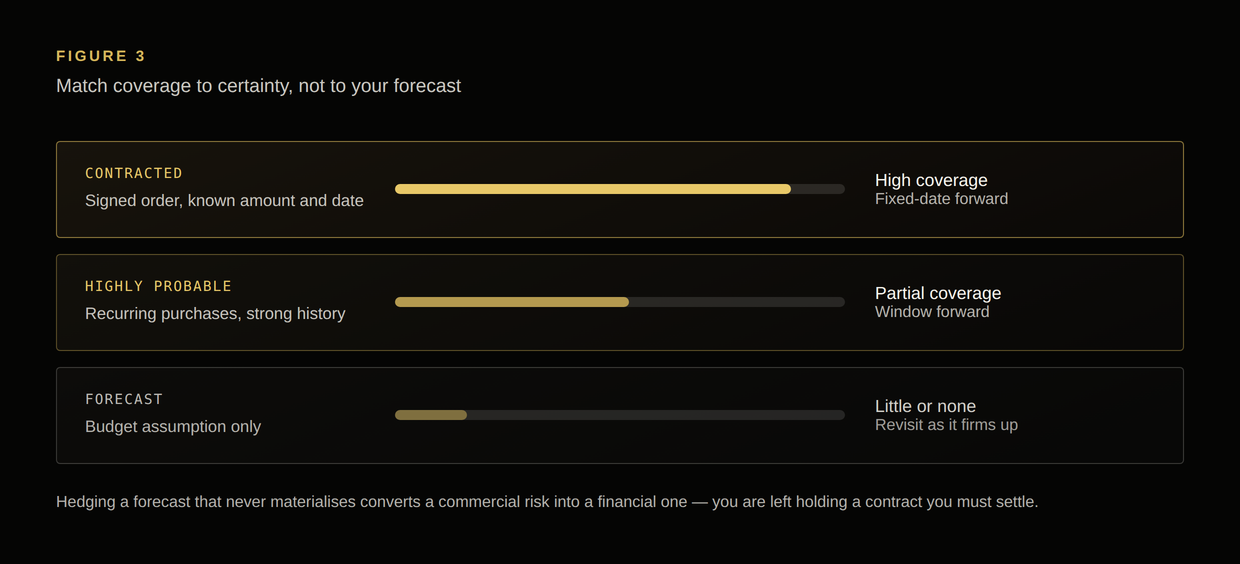
Coverage should follow the certainty of the exposure, not the strength of your view on the currency.
How quickly you can reprice. A business that can pass currency movements to customers within a quarter needs less hedging than one on a fixed annual price list. The hedge substitutes for pricing flexibility you do not have.
How much of your cost base is foreign. If 5 percent of costs are USD-denominated, currency is a rounding error. At 60 percent, it is the largest single driver of margin and deserves board-level attention.
A workable starting point for most businesses: cover contracted exposures heavily, cover recurring and highly probable exposures partially, and leave pure forecast alone until it firms up.
The practical mechanics
Credit and margin. Because a forward can move against you before settlement, providers assess credit before agreeing to one. That means either a credit facility with nothing paid up front, or initial margin held as collateral for the life of the trade, with variation margin called if the position moves against you beyond a threshold. Requirements vary by provider, currency pair and tenor. The planning point that matters is that a margin call is a cash-flow event. Before hedging a large exposure a long way out, work out what an adverse move would ask of your working capital.
Contract types worth knowing.
- Fixed-date forward settles on one specific day. Best for a contracted payment with a known date.
- Window forward settles any time within a date range. Best when you know the month but not the day.
- Drawdown forward settles in instalments against a single contract. Best for staged payments or milestone billing.
If the date moves. A forward can usually be rolled to a later date. The roll is priced at prevailing forward points plus any gain or loss on the original contract, so it is neither free nor neutral. If the transaction disappears entirely, closing out early crystallises whatever the position is worth at that moment.
Documentation. Expect a master agreement plus a confirmation per trade. Read the close-out and margin-call provisions specifically. Those are the terms that matter on the day something goes wrong, and they are rarely the ones read at onboarding.
Five common mistakes
- Judging the hedge after the fact. The claim that you would have done better unhedged is the wrong test. The hedge bought certainty; it was never a bet. Businesses that grade hedges on hindsight tend to stop hedging just before they need it.
- Hedging gross instead of net. If you both buy and sell in USD, offset those flows first. Netting costs nothing and removes exposure at source. Hedge only the residual.
- Hedging a forecast as though it were an order. The most common route to holding currency you do not need.
- Choosing a fixed date when the timing is genuinely uncertain. A window forward exists precisely for this and avoids a chain of rolls.
- No written policy. Without one, hedging becomes a series of ad-hoc decisions made under pressure, and nobody can say afterwards whether the policy was followed, because there was not one.
Questions worth asking a provider
- What are the forward points on this quote, and how do they compare to the interest rate differential?
- Do you require a credit line or margin, and what would trigger a margin call?
- Do you offer window and drawdown forwards, and how does pricing differ?
- What does it cost to roll or close out early?
- Who is the counterparty to my contract?
A short checklist before your first forward
- Is the exposure contracted, highly probable, or just forecast?
- Do I know the settlement date, or only the month?
- What budget rate is this hedge protecting?
- What proportion am I covering, and why that proportion?
- Have I netted opposing flows in the same currency first?
- Does this need credit or margin, and can my cash flow absorb a call?
- What happens if the transaction is delayed or cancelled?
- Is the policy written down, with a named approver and a review date?
In summary
A forward converts an unknown future cost into a known one. It does not improve the rate, predict the market, or generate profit, and any framing that suggests otherwise is worth treating with caution.
Its value is that it lets a business price, plan and commit without the currency market having a vote. For companies whose margins are thin enough that a few percentage points of currency movement matter, that certainty is usually worth more than the upside it forgoes.
This guide is general information for Canadian businesses and does not constitute financial, accounting, legal or tax advice. Forward contracts carry obligations and risks, including the obligation to settle regardless of subsequent market movements. Accounting treatment varies by reporting framework and should be discussed with your accountant before trading. Consider your own circumstances and seek professional advice before entering into any hedging arrangement.