
The email usually arrives about a week after the payment. The supplier says the money came up short — a few hundred dollars against an invoice you are certain you settled in full. Your bank statement shows the full amount leaving your account. Neither of you is wrong.
Between those two facts sits a payment chain nobody described when the account was opened. The money left at one number and arrived at another, and the difference was taken in transit by institutions you did not choose and cannot see.
This guide covers where that difference comes from, why it is hard to predict in advance, and which parts of it a business can control. Some of it is genuinely outside your reach. More of it than most businesses realise is a contract term rather than a banking mystery.
Rideau Components is an illustrative Ottawa industrial distributor used throughout this guide — not a real company. It sends roughly 210 overseas payments a year, averaging about CAD 20,000 each, split between a supplier in Vietnam invoiced in US dollars and one in northern Italy invoiced in euros.
Two costs inside one payment
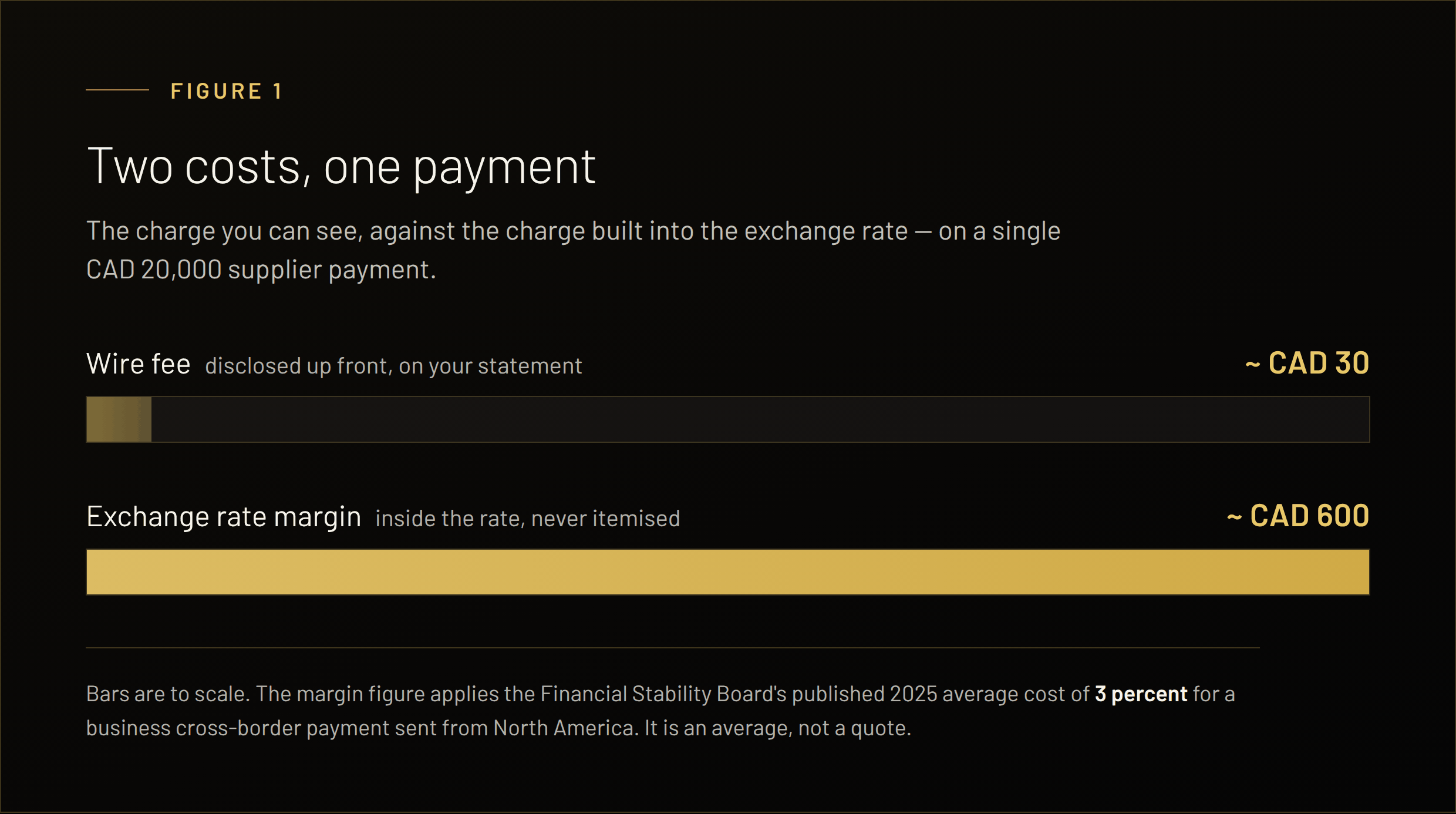
Every international payment carries two costs, and they are not the same size.
The first is the wire fee — flat, disclosed up front, printed on the statement. It is the cost most businesses think of as the cost of the payment.
The second is the exchange rate margin: the gap between the rate you are given and the interbank rate the market is trading at. It is built into the rate rather than charged as a fee, so it never appears as a line item anywhere.
The second is almost always the larger. The Financial Stability Board's 2025 monitoring of the G20 cross-border payments targets found that FX costs remained the largest component of overall cost, as in previous years.
The scale is worth sitting with. The same data puts the average cost of a retail cross-border payment sent from North America at or above 3 percent for every use case except person-to-business. The business-to-business measurement uses a USD 20,000 transfer — almost exactly Rideau's average payment. Three percent of CAD 20,000 is roughly CAD 600. The wire fee on the statement might be CAD 30.
Across 210 payments a year, that is the difference between a rounding error and a line worth managing.
The route a payment takes
There is no single global payments network in the way there is a single postal system. Banks settle cross-border payments through correspondent banking: as the Bank for International Settlements describes it, a correspondent bank provides local account and payment services for banks based abroad. Instructions travel as messages; the money moves by debiting and crediting accounts the banks hold with one another.
The consequence is direct. Depending on which relationships are in place, several payments between different intermediary banks may be needed for a single underlying transaction — what the BIS calls a payment chain.
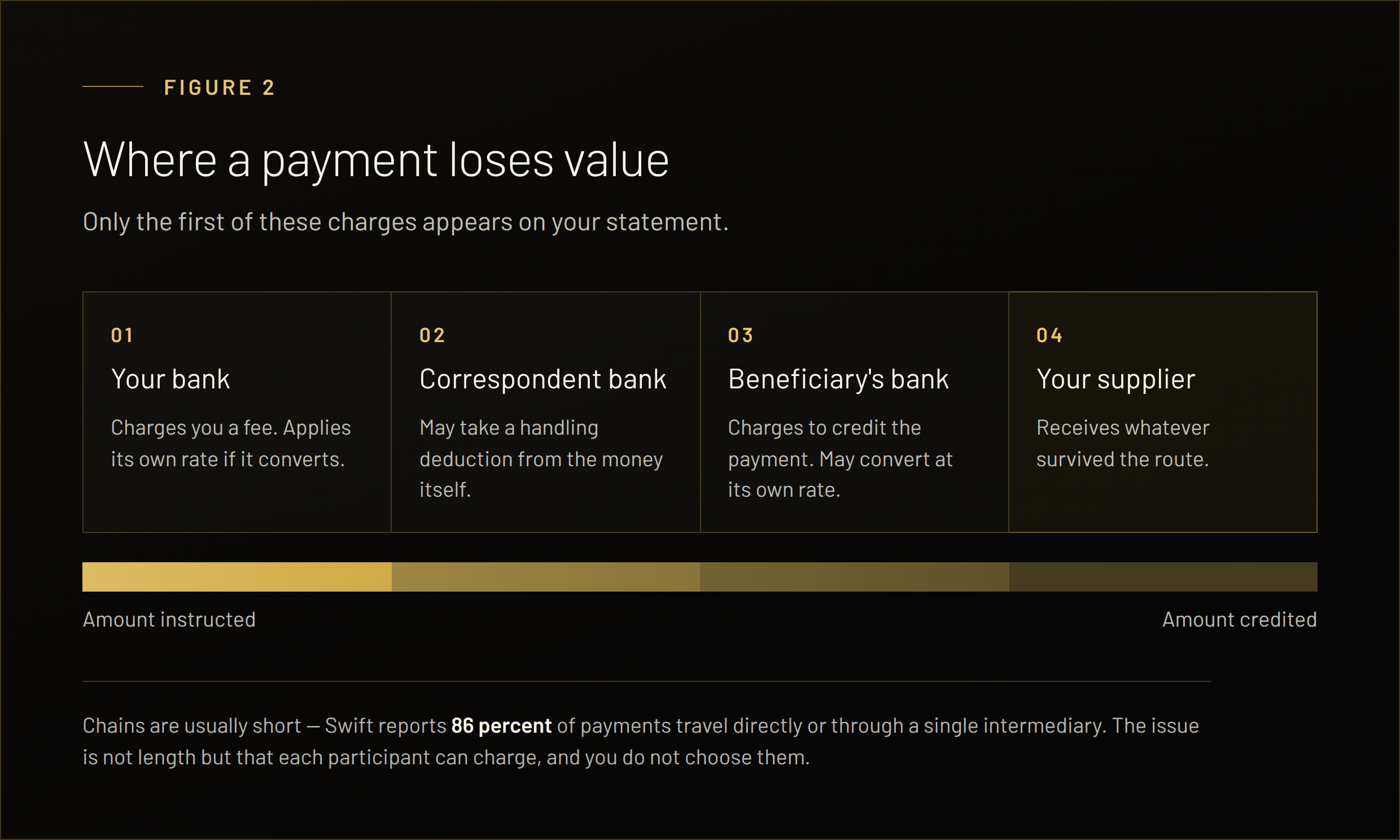
Those chains are shorter than folklore suggests. Swift's own network data indicates that 86 percent of payments travel directly or through a single intermediary. The problem is not usually chain length. It is that every institution touching the payment can take something, and you do not choose which institutions those are.
Corridor matters. The BIS Committee on Payments and Market Infrastructures tracked active correspondent relationships and active corridors falling year after year across every region, with the steepest declines in emerging markets and small island states. Where a corridor thins, payments route further to find a bank that still holds the relationship. Rideau's euro payment to Italy travels a well-served corridor. Its US dollar payment to Vietnam does not.
Where correspondent deductions come from
Three separate things reduce the amount that lands.
Handling deductions in transit. An intermediary bank processing the payment may take a fee from the principal, sometimes called a lifting fee. It comes out of the money rather than being billed to you, which is why it never reaches your statement.
Receiving-side charges. The beneficiary's bank commonly charges to credit an inbound foreign payment. The FSB surveys these directly and found receiver-side costs averaging between 0.1 and 1.3 percent of the amount sent, affecting lower-value payments disproportionately. Critically, it notes these costs may either be deducted from the amount the customer receives or invoiced between institutions in the chain — which is exactly why they are invisible from the sending end.
A second conversion at the far end. If the payment arrives in a currency the beneficiary's account does not hold, their bank converts it at their own rate. The FSB puts these additional receiving-side FX margins at 0.7 to 1.1 percent globally.
This is why "how much will my supplier receive" is a genuinely hard question for your own bank to answer. The route is not fixed when you send, and the deductions further down are set by institutions with no relationship to you.
Charge instructions: OUR, SHA and BEN
Every international payment carries an instruction saying who pays for it. Most businesses have never been asked to choose one.
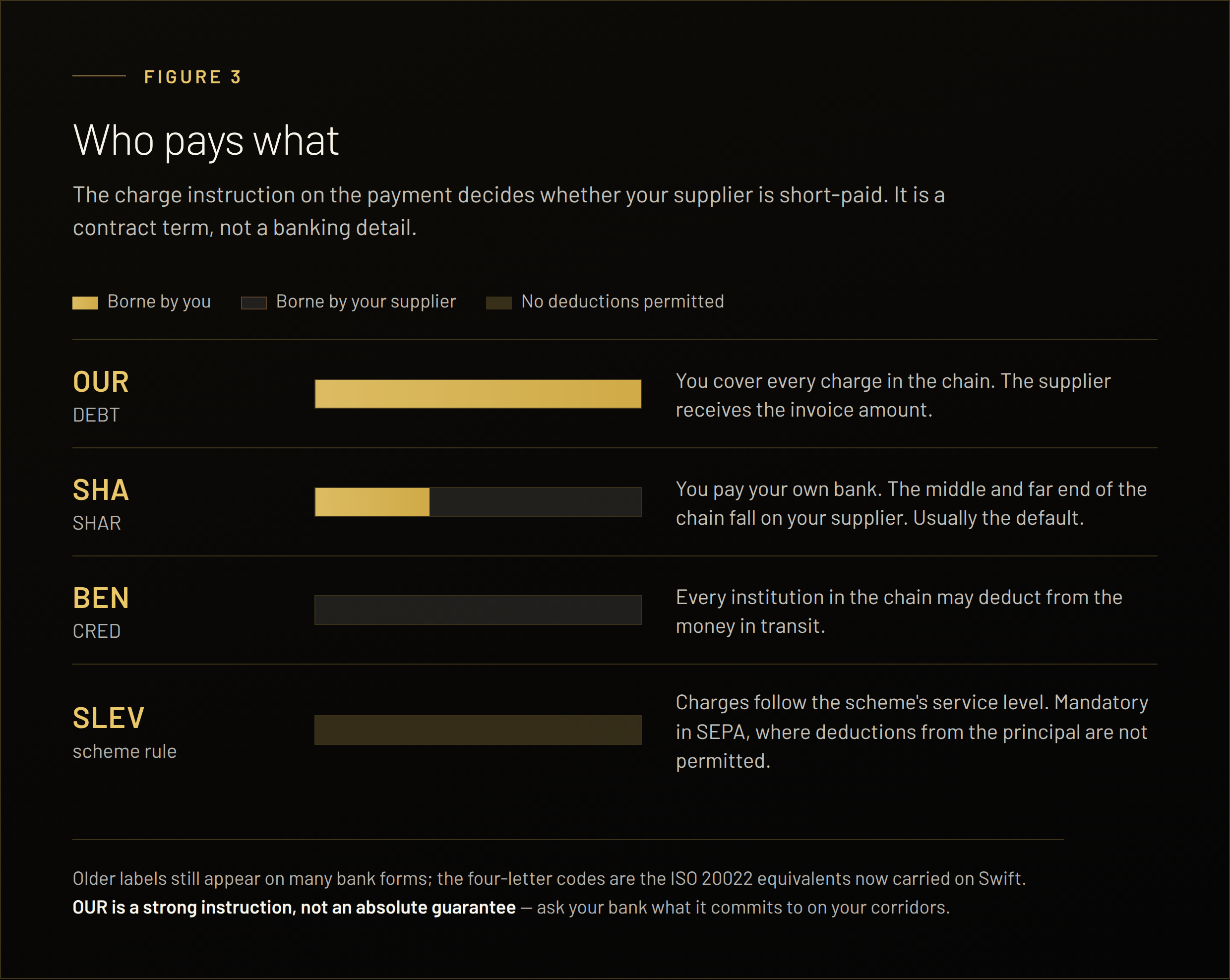
Historically these were OUR, SHA and BEN. Since Swift's cross-border messaging moved fully to ISO 20022 — the coexistence period ended on 22 November 2025 — the equivalents are DEBT, SHAR and CRED, plus SLEV. Many banks still print the old labels. They mean the same things.
- OUR / DEBT — the sender covers everything. In the Federal Reserve's description, the originator is responsible for all fees associated with the payment, including those of any intermediaries and of the beneficiary's bank. The supplier receives the invoice amount.
- SHA / SHAR — shared. The originator pays their own bank's fees; the beneficiary covers their bank's. In practice this leaves the middle and far end of the chain landing on your supplier. It is the most common default.
- BEN / CRED — the beneficiary bears everything, which means every institution in the chain may deduct fees, reducing the amount that reaches them.
- SLEV — charges follow the scheme's service level. This is the mandatory code within SEPA, where deductions from the principal are not permitted.
The practical point is not which code is best. It is that the choice determines whether your supplier is short-paid, and almost nobody negotiates it. If your contract says the supplier receives the invoice amount net of all charges, the instruction should be OUR, and your own cost rises accordingly. If the contract says nothing, you are relying on a default that quietly assigns the cost to the party least able to see it coming.
One caveat worth stating plainly: OUR is a strong instruction, not an absolute guarantee. Institutions outside your bank's direct relationships do not honour it uniformly on every corridor. Ask your bank what it will commit to on the specific routes you use.
Why a wire is hard to track
Tracking exists. It is just not pointed at you.
Every payment instruction carries a UETR — a 36-character reference that stays with the payment for its whole journey and lets participating banks see where it is. It is the closest thing cross-border payments have to a parcel tracking number.
What does not exist is a customer-facing tracker. You cannot look up your own UETR. You ask your bank, and your bank reads the status for you. Whether that is a two-minute call or a two-day investigation depends on your bank's operations, not on the technology.
The delay usually sits at the end rather than the middle. The FSB attributes recent speed gains to faster processing at the beneficiary leg — the stretch between the receiving provider getting the instruction and crediting the customer's account — which it describes as traditionally the slowest part of the transaction. For business-to-business payments sent from North America, it records fewer than 3 percent credited within an hour.
Transparency is improving from a low base. Globally, the share of services disclosing both cost and speed rose 7.3 points to 62.9 percent in 2025. For B2B payments sent from North America, the comparable figure is around 25 percent.
ISO 20022 should help over time. The standard carries structured charges information, and the Federal Reserve's guidance is that fees deducted from a wire must be documented with both the amount and the institution that took them. That is the raw material for an answer to "who took what." Whether your bank surfaces it to you is worth asking now.
What a business can do about it
Most of the recoverable cost is recovered before the payment is sent, not chased afterwards.
- Pay in the supplier's currency where you can. It removes the second conversion at the far end and moves the FX margin into a quote you can compare rather than a deduction you discover.
- Send fewer, larger payments. Deductions are largely fixed per transaction, which is why the FSB finds they bite hardest on small ones. Consolidating four monthly payments into one, where terms allow, removes three sets of them.
- Reconcile against the payment advice, not the invoice. Short payments are found in reconciliation or not at all. A process that only confirms a payment was sent surfaces the gap months later, as a supplier complaint.
In summary
The gap between what you send and what your supplier receives is not a fault. It is the design of a system built on bilateral bank relationships, in which every participant that touches a payment can charge for doing so, and only the first charge is disclosed to you.
You cannot see the whole chain. You can decide who pays for it, insist on a rate you can compare against a public benchmark, keep the reference that makes a payment findable, and stop sending four payments where one would do. For a business making a couple of hundred overseas payments a year, that is the difference between a cost that is managed and one that only ever surfaces as an awkward email.
This guide is general information for Canadian businesses and does not constitute financial, legal, accounting or tax advice. Payment routing, charges and settlement practices vary by bank, corridor and currency, and the figures cited are published averages rather than quotes. Confirm charge-bearer handling and cost disclosure with your own provider before relying on any of the above.
Sources: Financial Stability Board, G20 Roadmap for Enhancing Cross-border Payments — Consolidated progress report for 2025 (9 October 2025); Bank for International Settlements, CPMI quantitative review of correspondent banking data; Swift, network routing and speed data, and ISO 20022 CBPR+ implementation guidance; Federal Reserve Financial Services, ISO 20022 post-implementation guidance on charge bearer codes; Bank of Canada, Registry of Payment Service Providers under the Retail Payment Activities Act; FINTRAC money services business registry.