
The conversation happens in February, with the draft financial statements on the table. There is a line on the income statement — foreign exchange loss — and it is large enough that someone asks about it.
The question that follows is always the same. When did that money leave?
It didn't. Nothing was paid, no transfer failed, no rate was missed. The business simply held foreign-currency balances on the last day of the year, and those balances were restated into Canadian dollars at the rate on that day rather than at the rate on the day each one arose. The difference is the loss. It is on the income statement, it is inside the number that went to the lender, and it is not in the bank account.
This guide is about that number: which balances produce it, why it behaves the way it does, and what is worth doing about it. Everything in it follows from one distinction, so it is worth stating at the top. Hedging your balance sheet manages when a currency movement is recognised in your reported results. Hedging a transaction manages what a payment costs in cash. Those are different jobs. They occasionally pull in opposite directions, and a business that has not decided which one it is doing will hedge inconsistently and be annoyed by the outcome.
Cobequid Instruments is an illustrative Dartmouth, Nova Scotia manufacturer of marine navigation and sonar instruments, used throughout this guide — not a real company. It sells to dealers along the US eastern seaboard and invoices them in US dollars. It buys transducers and electronics from US suppliers, also in US dollars. It financed a test tank with a US dollar equipment loan, and it keeps a US dollar operating account so that receipts can pay suppliers without a round trip through Canadian dollars. Its year end is 31 December.
Which balances revalue
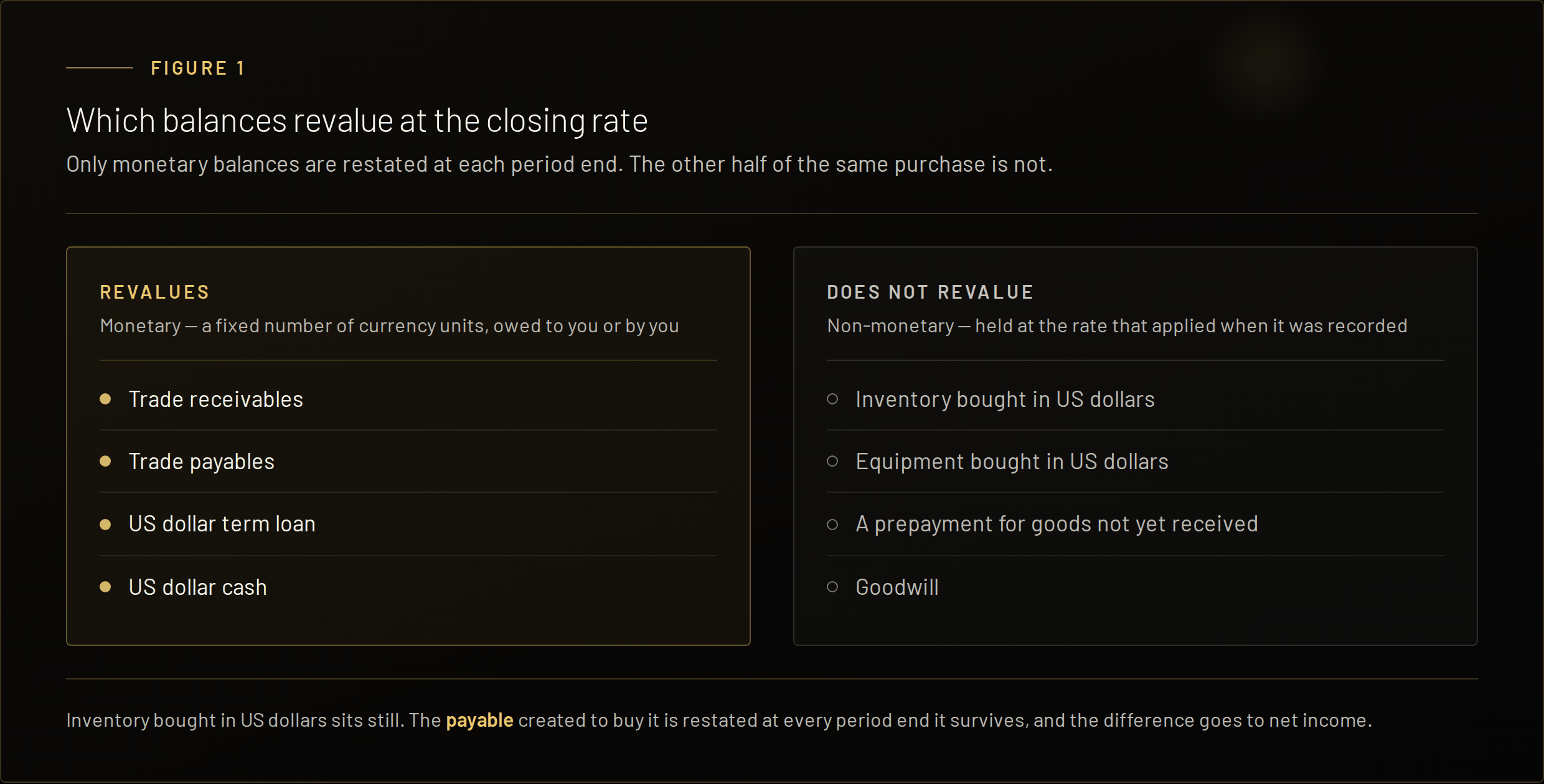
Under Canadian accounting standards for private enterprises, the balances that get restated at each period end are the monetary ones — items that are a fixed number of currency units, either owed to you or by you. Accounts receivable, accounts payable, cash, and loans are monetary. They are adjusted at each balance sheet date to the exchange rate in effect on that date, and the resulting gain or loss goes into net income for the period.
Non-monetary items are not restated. They stay at the exchange rate that applied when they were recorded — unless they are carried at market, in which case they are translated at the balance sheet date rate as well. For most businesses that exception does not arise, and the working rule holds.
That distinction does most of the explanatory work here, and it is the source of the most common confusion in the room. Inventory bought in US dollars does not revalue. The payable created when you bought it does. Once the payable is settled, the inventory sits on the balance sheet at whatever Canadian dollar figure it was recorded at and stays there, unmoved by the currency, while the payable moved every period it was outstanding. Two halves of one purchase, treated in opposite ways.
Why the loss is real in the accounts and not in the bank
Two words separate the two kinds of currency gain and loss on the income statement, and only one of them involves money.
A realised gain or loss happens when a balance is settled. You invoiced a customer USD 100,000, they paid, you converted, and the Canadian dollars you received differ from the Canadian dollars you booked. Cash moved and the difference is final.
An unrealised gain or loss happens when a balance is still outstanding at the period end and gets restated. Nothing settled. Nothing moved. The balance is simply being measured again, at a new rate, because the reporting date arrived.
Both land in net income. Only one of them has happened.
The awkward part is that unrealised movements reverse, and the reported number does not. Take the Bank of Canada's published daily rate for the US dollar at the four quarter ends of 2025: 1.4376 at 31 March, 1.3643 at 30 June, 1.3921 at 29 September — the Bank's last publication before the quarter end, 30 September being a federal holiday — and 1.3706 at 31 December. The direction changed twice in a single year.
A business holding net US dollar assets through that year would have reported a loss, then a larger loss, then a gain that gave back a good part of it, then a loss again. Each of those numbers was correct on the day it was struck. Each one also went into a set of statements that someone read — a lender testing a covenant, a board reviewing a quarter, a buyer looking at a trailing twelve months. The rate reverses. The reported number has already left the building.
Where the volatility actually comes from
Not all monetary balances contribute equally. Three tend to dominate, and they are not the ones businesses watch.
Long-dated receivables. A 30-day receivable will rarely be outstanding across a period end, and if it is, it is measured once. A 90- or 120-day receivable is measured at every period end it survives, and a balance measured four times contributes four movements.
Foreign-currency debt. This is usually the largest single item and the least examined, because it does not feel like a currency position. It feels like financing. But a US dollar term loan is a monetary liability, so its Canadian dollar carrying amount is restated at every period end for the whole life of the loan. A five-year loan is twenty quarterly revaluations of the entire outstanding principal. Cobequid's test tank loan moves the income statement more than its trade payables do, and nobody involved in arranging it was thinking about foreign exchange.
Idle foreign-currency cash. A US dollar account is convenient, and convenience is the reason balances accumulate in it. Cash is monetary, so an unused balance is a live position that is revalued every period and does no work in between.
The net monetary position
Before hedging anything, work out what the exposure actually is — because it is almost certainly smaller than the sum of its parts.
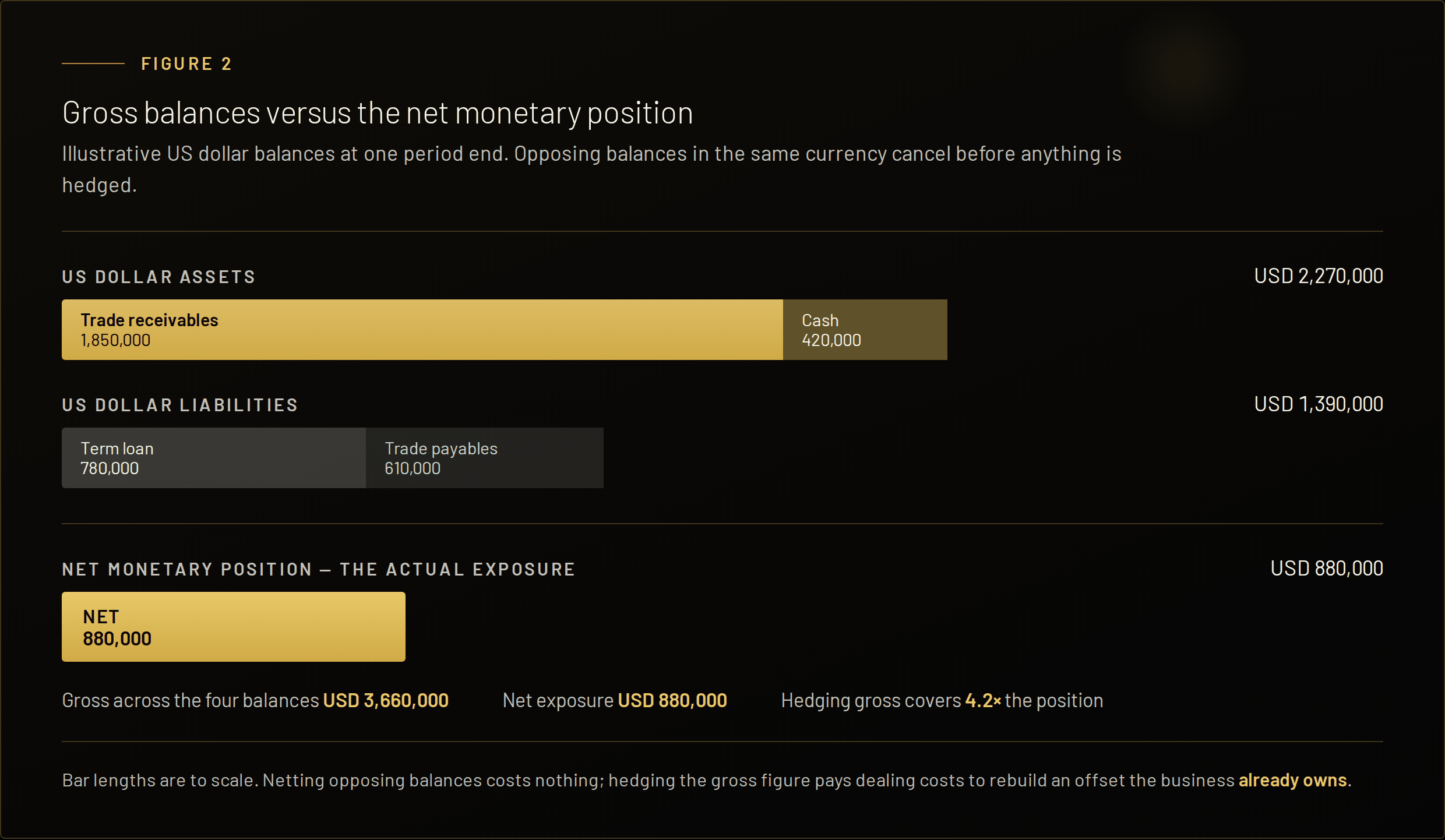
Cobequid's US dollar balances at a period end, illustrative figures:
- Trade receivables — USD 1,850,000
- Cash in the US dollar account — USD 420,000
- Trade payables — USD 610,000
- Test tank term loan — USD 780,000
The assets total USD 2,270,000 and the liabilities USD 1,390,000. The net monetary position is a US dollar asset of USD 880,000. That is the number a rate movement acts on. The gross figure — USD 3,660,000 across the four lines — is not an exposure at all. It is four exposures, most of which cancel.
The arithmetic that follows is illustrative, derived from published rates. The US dollar's first published Bank of Canada rate of 2025 was 1.4422, and its last was 1.3706, a fall of 0.0716. Applied to a net US dollar asset of 880,000, that is a movement of roughly CAD 63,000 — a loss, on the income statement, with no payment made and no transfer executed all year.
Now the reason this section comes before the hedging section. A business that hedged each of those four lines separately would have entered forwards on USD 3,660,000 to manage an exposure of USD 880,000. It would have paid dealing costs on four times the position it had, and rebuilt, at its own expense, the offset it already owned for nothing. Netting opposing balances in the same currency is free. It is the first thing to do and the most reliably skipped.
Hedging the net position
Once the net position is known, the instrument is not exotic. A forward covering the net amount, running to the next reporting date, is the ordinary answer. How forwards are priced and what they commit you to is set out in Forward Contracts, Explained, and is not repeated here.
What differs is the tenor logic, and it differs enough to be worth flagging, because it is the opposite of the approach in A Hedging Playbook for Canadian Importers.
Transaction hedging matches a specific payment. The date is known, the amount is known, and cover is added in layers ahead of it, further out as certainty builds. The ladder reaches forward.
A balance sheet position has no settlement date, because it is not a transaction. It is a photograph of everything outstanding at one moment, and the moment that matters is the next reporting date. The balance changes continuously as invoices are raised and settled, so cover is struck against the position as it stands, held to the reporting date, and then re-struck against whatever the position has become. Short tenors, repeated, rather than long tenors, laddered.
One consequence deserves emphasis, and it is the pivot of this guide. A forward settles in cash. Using one to manage a non-cash accounting movement introduces a real cash gain or loss where there previously was none. That trade may well be worth making. It should be made knowingly.
The credit and margin mechanics are the same as for any forward, including the possibility of a margin call while the position moves against you. The Hedging Playbook covers that trap in detail; it applies here unchanged.
Two objectives, and where they conflict
Here is where the distinction becomes concrete, and it is not quite where most people expect it.
Cobequid has two foreign-currency exposures, and they are different shapes.
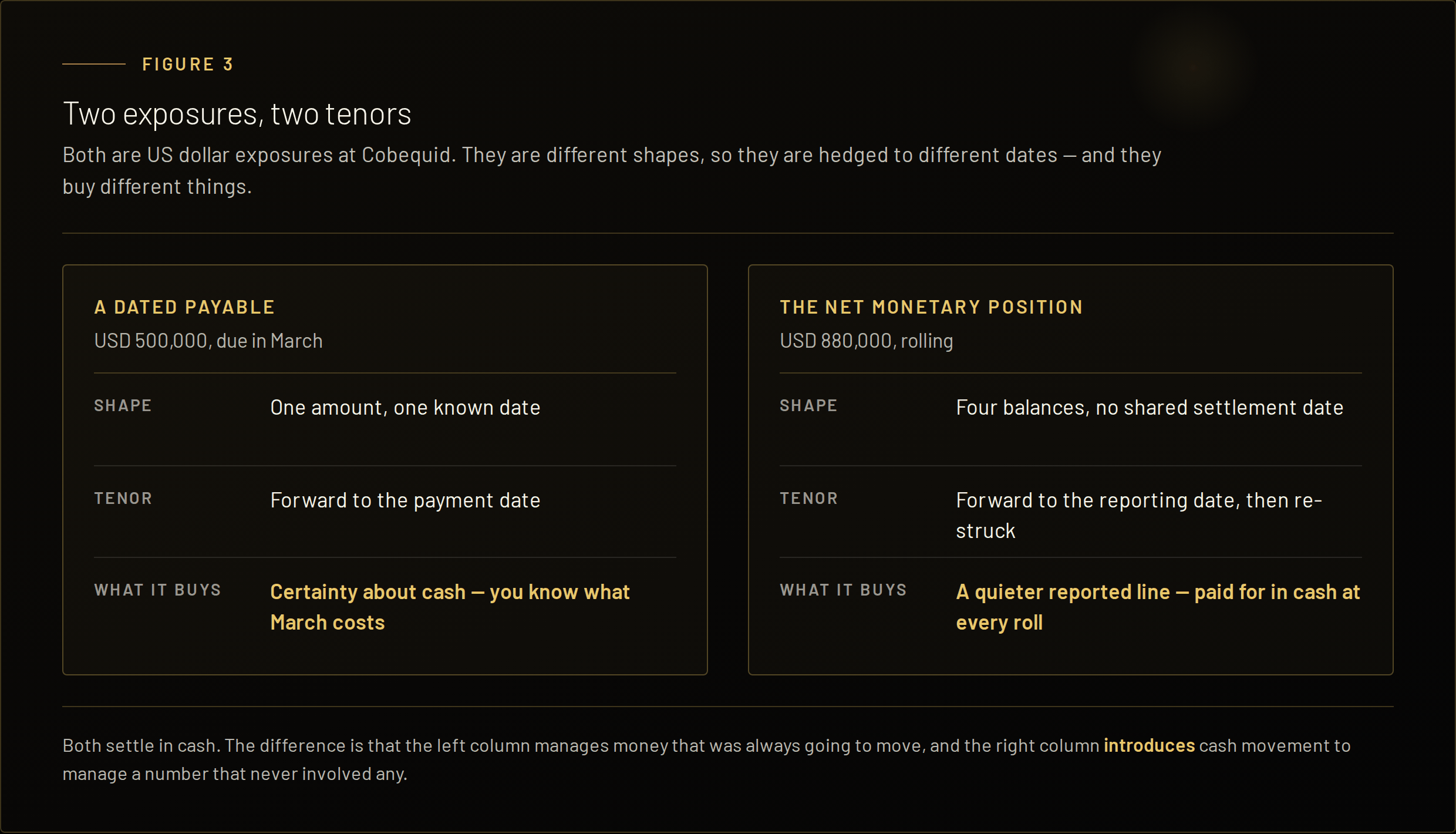
The first is the US dollar payable of 500,000 falling due in March. It is dated, known and individual. A forward to the March payment date fixes what it costs in Canadian dollars. It also sits in the year's accounts: the payable is revalued through net income, and a forward that is not in a designated hedging relationship is carried at fair value with its changes going through net income as well. Both legs are already landing in the same period. How closely they offset is a question for your accountant, but they are not falling into different years.
The second is the net monetary position — USD 880,000 made up of receivables, cash, payables and a loan, none of which share a settlement date and all of which change every week. There is no payment date to match, because it is not a payment. The only date that means anything is the next reporting date. So cover is struck against the position as it stands, held to that date, and re-struck against whatever the position has become.
That is the conflict, and it is a conflict about what you are buying. Hedging the dated payable buys certainty about cash: you know what March costs. Hedging the net position buys a quieter reported line — and it buys it by introducing cash movements, because the forward settles in money at every roll, in order to manage a number that never involved cash in the first place.
A business that hedges the net position and then judges the result by whether individual payments came in on budget will conclude that hedging failed. So will a business that hedges payment by payment and then wonders why its year-end foreign exchange line is still moving — it is moving on the receivables, the cash and the loan, which were never covered. Both are measuring against an objective they did not choose.
Decide which one you are buying. Then choose the tenor.
Hedge accounting, briefly
The reason hedge accounting exists is a timing problem. A hedging instrument and the thing it hedges can be recognised in different periods, which makes a business that is well hedged in economic terms look volatile in its reported results. Hedge accounting lines the two up.
For Canadian private companies reporting under ASPE, it sits in Section 3856 of the CPA Canada Handbook. Three things about it are worth a business owner's attention, and none of them require understanding the mechanics.
It is optional. It is also available only for a closed list of relationships. Under Section 3856 an entity may designate only these:
- An anticipated foreign-currency transaction hedged with a forward contract
- An anticipated purchase or sale of a commodity hedged with a forward contract
- An interest-bearing asset or liability hedged with an interest rate swap
- A foreign-currency-denominated interest-bearing asset or liability hedged with a cross-currency interest rate swap
- A net investment in a self-sustaining foreign operation
Read that list against this guide. Hedging a receivable or payable you have already booked, using an ordinary forward, is not on it. Nor does it need to be, in the sense that matters here: the balance is revalued through net income, and an undesignated forward is carried at fair value with its changes also going through net income. They are already in the same period. Whether they offset closely enough to leave your reported line quiet is a question for your accountant, not a matter of election.
The list covers the situations where a genuine mismatch can arise. The one most likely to reach a business at this scale is the first — a purchase or sale you expect to make but have not yet recorded. That is transaction hedging, not balance sheet hedging, and it is the subject of the Hedging Playbook.
Where hedge accounting does apply, it requires designation and formal documentation at the inception of the hedging relationship — set up in advance, at the time of the trade. It cannot be applied retroactively at the year end, once the volatility has already appeared, which is precisely when most people first hear the term.
Which is where this section ends. If your reported foreign exchange line is volatile enough to be a problem, that is a conversation with your accountant, held before you trade rather than after. Take them the net monetary position and the tenor you are considering. IFRS filers face a different set of requirements under IAS 21 and IFRS 9 and should not assume any of the above transfers.
A note on foreign subsidiaries
This is a different problem, and worth naming only so it is not confused with the one above.
Everything so far concerns foreign-currency balances held by a Canadian company. A foreign operation — a subsidiary or branch that keeps its own books in another currency — is translated rather than revalued, and where it goes depends on how it is classified. A foreign operation that is financially and operationally independent of the Canadian parent is translated using the current rate method, and the resulting exchange differences are recognised in a separate component of shareholders' equity, commonly called the cumulative translation account, rather than in net income. An operation that is interdependent with the parent is translated using the temporal method, and its differences do go through net income.
The classification is a judgement, and it is the whole ballgame — it decides whether translation differences touch your reported earnings at all.
If you have a foreign subsidiary and your exchange differences are landing in equity rather than income, the problem in this guide is not your problem, and hedging a net investment in a foreign operation is a separate and more involved exercise. It is not where a business at this scale should start. Under IFRS the equivalent differences sit in other comprehensive income; ASPE has no such statement, which is why the wording differs.
What to do
Three steps, in order, and the first two cost nothing.
- Establish the net monetary position. List every foreign-currency balance at your last period end — receivables, payables, cash, loans — by currency. Not the transactions. The balances. Most businesses have never seen this on one page.
- Net it. Assets against liabilities, within each currency. Whatever remains is the exposure. Whatever cancelled was never an exposure, and hedging it would have been a purchase of something you already had.
- Decide what you are managing. Reported earnings, or cash. Write the answer down in a sentence. It determines the tenor, and it is the only defence against judging the result against the objective you did not choose.
In summary
The foreign exchange loss at the bottom of your income statement is not an error and not a payment. It is the arithmetic of measuring foreign-currency balances again on a date that has nothing to do with when they settle.
You can reduce it, and most of the available reduction is free: know the net position, let the offsetting balances offset, and stop leaving idle currency in accounts that do no work. What remains can be hedged. Whether it should be depends on a question that is not really about currency at all — whether the number that matters to your business is the one you report or the one you pay.
Answer that first. The instrument is the easy part.
This guide is general information for Canadian businesses. It is not accounting, tax, financial or legal advice. Foreign currency translation and hedge accounting requirements differ between reporting frameworks, and the treatment of any particular balance, transaction or hedging relationship depends on the specific facts and circumstances of the entity. Descriptions of accounting treatment here are simplified and are intended to help you frame a conversation, not to determine an accounting position. Hedging does not improve reported results or guarantee a favourable outcome, and forward contracts carry obligations including the obligation to settle regardless of subsequent market movements. Consult your own accountant and advisers before adopting any accounting treatment or entering into any hedging arrangement.
Sources: Bank of Canada, daily exchange rates (USD/CAD, 2025); CPA Canada Handbook — Accounting, Part II, Section 1651 Foreign Currency Translation and Section 3856 Financial Instruments; BDO Canada, ASPE at a Glance summaries of Section 1651 and Section 3856, and A Guide to Hedge Accounting for Private Enterprises and Private Sector Not-for-Profit Organizations; IAS 21 and IFRS 9 for entities reporting under IFRS.